


You’re staring at your desk. Three textbooks. Two highlighters. One half-empty coffee cup. And a syllabus that looks like it was written by someone who hates students.
You’ve spent the last two hours “planning” your study schedule. You’ve color-coded subjects, created a spreadsheet, and blocked out time slots. But here’s the thing: you haven’t actually studied yet. And somehow, you feel more overwhelmed than when you started.
This is the study planning trap. Most students fall into it because they’re following a system designed for someone else not for them.
If you’re preparing for a competitive exam in 2026, whether it’s SSC, UPSC, banking, defense, or any other high-stakes test you need a different approach. Not a longer plan. A smarter one.
This guide will show you how to build a personalized study plan in 5 minutes that actually works. More importantly, it’ll explain why it works, so you can adapt it to your specific situation.
The Problem With Generic Study Plans
Let’s start with why your current approach is probably failing.
Traditional study plans treat all students the same. They assume:
- You learn at the same pace as everyone else
- You struggle with the same topics as everyone else
- You have the same amount of time as everyone else
- You’ll stick to a rigid schedule no matter what happens
- None of these assumptions are true.
Generic study plans fail because they ignore three critical realities: your unique learning gaps, your actual available time, and your brain’s forgetting curve.
1. The Efficiency Drain
When you follow a linear study plan—Chapter 1, then Chapter 2, then Chapter 3—you’re spending equal time on everything. But that’s not how exams work. Some topics appear in 30% of questions. Others appear in 2%
More importantly, some topics you already understand. You don’t need to spend an hour on something you’ve already mastered. But generic plans don’t know that. So you waste time feeling productive while your actual weak spots remain untouched.
SSC Guide reports that “without a structured plan, even the best strategy fails in implementation.” But the key word here is structured—not rigid.
2. The Retention Gap
Here’s something most students don’t realize: forgetting isn’t a failure. It’s how your brain works.
When you learn something new, you forget it. Fast. Within 24 hours, you’ve forgotten about 50% of what you learned. Within a week, it’s 70%. This is called the forgetting curve, and it’s not optional—it’s neuroscience.
The problem with generic plans is they don’t account for this. They assume that once you’ve “covered” a topic, you’re done with it. You move on to the next chapter. But your brain is already forgetting the previous one.
Long Term Memory explains: “The problem usually isn’t the number of hours. It’s the shape of those hours, when they happen, how long each stretch runs, what goes in them, and how much recovery sits between them.”
3. The Burnout Trap
Generic plans also set unrealistic daily targets. They don’t account for:
- Days when you’re tired or sick
- Days when you have other commitments
- Days when a concept just doesn’t click
- Days when you need a mental break
When you inevitably miss a day, the plan falls apart. You feel guilty. You try to “catch up” by studying 8 hours the next day. That doesn’t work either. So you give up.
Why Personalization Changes Everything
A personalized study plan is different. It’s built around you—your strengths, your gaps, your schedule, and your brain’s actual learning patterns.
Here’s what changes:
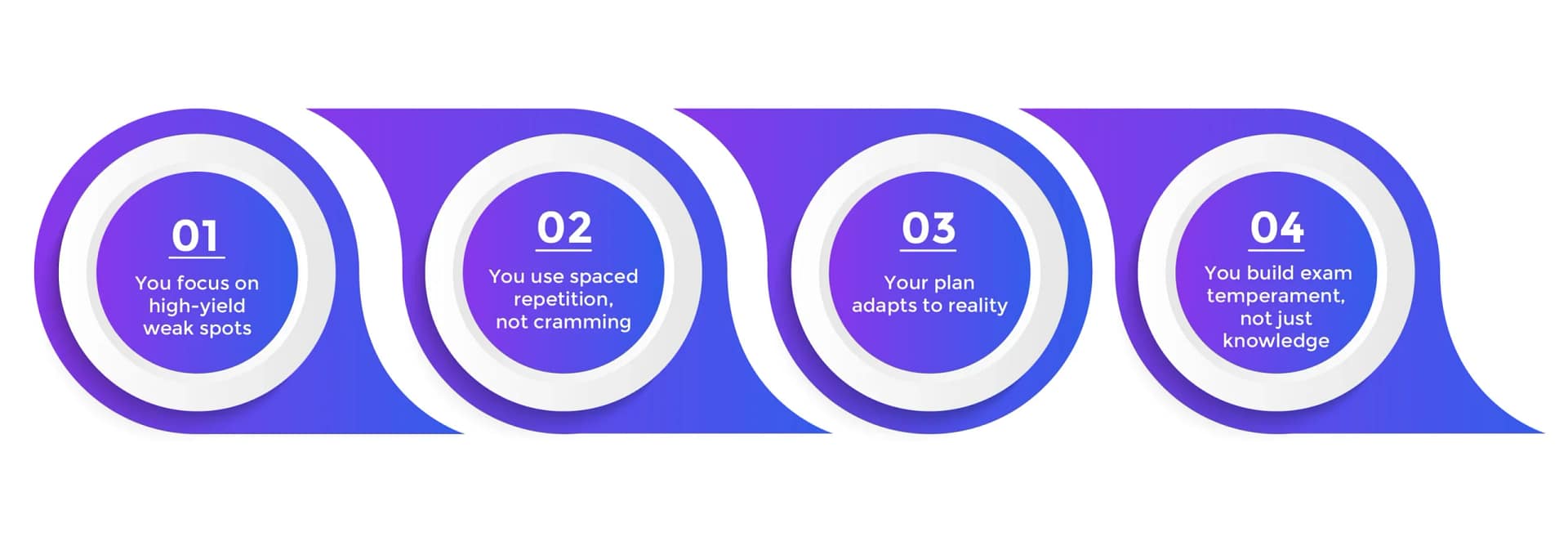
1. You focus on high-yield weak spots
Instead of studying everything equally, you identify the topics that:
Appear frequently in exams (high-yield)
You struggle with (high-gap)
These topics get 60% of your study time. Everything else gets the remaining 40%.
Career Launcher recommends this approach: “Since time is limited, you must be mindful of how you divide it.” The key is identifying focus areas early.
2. You use spaced repetition, not cramming
Instead of studying a topic once and moving on, you revisit it at strategic intervals. This aligns with how your brain actually retains information.
Study Spaces confirms: “Research on learning and memory finds that spreading practice over multiple days and using active recall leads to better long-term retention than one big cram session the night before.”
3. Your plan adapts to reality
A personalized plan isn’t a contract. It’s a hypothesis. You test it each week, see what works, and adjust. If you’re falling behind in one area, the plan shifts. If you’re ahead in another, you move faster.
4. You build exam temperament, not just knowledge
Knowing the material is only half the battle. You also need to practice under exam conditions—timed, with pressure, with distractions. A personalized plan builds this in from day one.
The 5-Minute Framework: Step by Step
Now, let’s build your plan. This actually takes 5 minutes. Here’s how.
1. Step 1: The Zero-Hour Assessment (1 Minute)
Before you can plan, you need to know where you stand.
Take a diagnostic test. This isn’t a full mock exam—it’s a quick assessment of your current level. If you’re preparing for SSC CGL, take a 30-minute diagnostic. If you’re preparing for UPSC, take a 1-hour diagnostic.
What you’re looking for:
- Your overall score (this is your baseline)
- Your accuracy by topic (which areas are you getting right?)
- Your speed (are you running out of time?)
- Your confidence (which topics do you feel unsure about?)
Don’t just look at the final score. Look at the breakdown. This is where your personalization starts.
Example: If you’re preparing for SSC CGL and your diagnostic shows:
- Quantitative Aptitude: 65% accuracy
- Reasoning: 78% accuracy
- English: 52% accuracy
- General Awareness: 41% accuracy
Your weak spots are English and General Awareness. These get priority.
Step 2: Set Your Target Date and Goals (1 Minute)
Input two things:
Your exam date – This creates urgency and helps you calculate how much time you have
Your target score – Be realistic, but ambitious
The combination of these two creates your “pressure point”—how much you need to improve, in how much time.
Example: If your exam is 6 months away and you need to go from 52% to 75% in English, that’s a 23-point improvement in 26 weeks. That’s roughly 1 point per week. Achievable, but it requires focus.
Oswal Books notes: “The 30 days leading to the UPSC Prelims can either make or break your score, and the correct strategy of revision is the key to success.”
The same principle applies to your entire preparation timeline. Every week matters.
Step 3: Identify Your High-Yield, High-Gap Topics (1 Minute)
Student-Focused Tone: Find the Topics That Can Boost Your Score in 1 Minute
AI/Performance-Driven Tone: Discover High-Scoring Topics Where You Need the Most Improvement—In 60 Seconds
Short & Catchy: Spot Your Weakest High-Impact Topics in 1 Minute
Exam Prep Tone: Know Which Topics Need Your Attention Most—In Just 1 Minute
More Engaging/Marketing Friendly: One Minute to Find the Topics That Matter Most for Your Exam Success
If this is for AI Faculty landing page/video copy, I’d recommend:
“Identify Your High-Yield, High-Gap Topics in Just 1 Minute”
It clearly communicates both exam relevance (“high-yield”) and personalized learning gaps.
How do you know what’s high-yield? Look at previous year question papers. Count how many questions come from each topic. That’s your yield.
How do you know what’s high-gap? Your diagnostic test told you.
Example for SSC CGL:
Step 4: Build Your Weekly Schedule (1 Minute)
Now you know what to study. Next, you need to know when.
Study Spaces recommends: “Start with the week you actually live, not the ideal one: real class times, commute, work shifts, and when you predictably have energy.”
Here’s a realistic weekly structure:
Daily study time: 3-4 hours for full-time students, 2-3 hours for working professionals
Weekly breakdown:
- Monday-Friday: 1 hour Priority 1 + 30 min Priority 2 + 30 min Priority 3
- Saturday: 2 hours Priority 1 + 1 hour mock test
- Sunday: 1 hour revision + 30 min planning for next week
Key principle: Short, regular sessions beat long marathons. Your brain retains more from five 1-hour sessions than one 5-hour session.
Step 5: Set Up Your Review Mechanism (1 Minute)
This is the part most students skip. And it’s the part that makes the difference.
Every week, review:
- What did I study? (List the topics)
- How did I perform? (Track your accuracy on practice questions)
- What’s working? (Which study methods are helping?)
- What’s not working? (Which methods are wasting time?)
- What do I adjust next week? (Based on the above)
This review loop is critical. Data Field Dev explains: “Schedules are forecasts, not contracts. Your first draft is a hypothesis. Each week, you adjust based on what actually happened. That review loop matters more than getting the perfect template on day one.”
The Science Behind Why This Works
Now that you have a framework, let’s understand why it works. This matters because when you understand the science, you can adapt the framework to your specific situation.
Principle 1: Spaced Repetition
Your brain forgets. But it forgets on a predictable schedule.
When you first learn something, you forget it quickly. But if you review it before you completely forget it, the forgetting curve resetsand you forget it more slowly the next time.
This is called spaced repetition, and it’s the most powerful learning technique we know.
A personalized plan builds this in. Instead of studying a topic once, you study it multiple times, with increasing gaps between sessions:
- First review: 1 day after learning
- Second review: 3 days after first review
- Third review: 1 week after second review
- Fourth review: 2 weeks after third review
By the time your exam arrives, you’ve reviewed the material 4+ times. It’s not just in your short-term memory. It’s in your long-term memory.
Principle 2: Active Recall
Passive reading doesn’t work. You can read a chapter 10 times and still forget it.
Active recall is different. It’s when you try to retrieve information from memory without looking at the source. This is what happens when you:
- Answer practice questions
- Explain concepts out loud
- Teach someone else
- Write summaries from memory
A personalized plan prioritizes active recall. You’re not just reading. You’re practicing. You’re testing yourself. You’re retrieving information from memory.
Learn hall Blog notes: “Research, such as a 2016 study in Journal of Educational Psychology, shows that structured study plans improve academic performance by enhancing time management, reducing procrastination, and increasing self-efficacy.”
Principle 3: Interleaving
Here’s something counterintuitive: studying different topics in random order is better than studying one topic at a time.
This is called interleaving. When you interleave, your brain has to work harder to distinguish between topics. This makes learning slower in the short term, but retention much better in the long term.
A personalized plan uses interleaving. Instead of studying “Percentage problems” for 3 hours straight, you study:
- 30 min Percentage problems
- 30 min Profit & Loss
- 30 min Simple Interest
- 30 min Percentage problems again
This feels less efficient, but it’s actually more effective.
Principle 4: Matching Task Difficulty to Energy Level
Your brain has different energy levels throughout the day. You’re sharpest in the morning, less sharp in the afternoon, and exhausted by evening.
A personalized plan matches task difficulty to energy level:
- High energy (morning): Learn new concepts, solve hard problems
- Medium energy (afternoon): Practice medium-difficulty problems, review
- Low energy (evening): Light review, organize notes, plan next day
- This simple adjustment can increase your productivity by 30-40%.
Common Mistakes (And How to Avoid Them)
Even with a personalized plan, students make mistakes. Here are the most common ones:
Mistake 1: Overestimating How Much You Can Study
Most students plan to study 6-8 hours daily. Then they burn out after 2 weeks.
Be realistic. If you’re a full-time student, 3-4 hours of focused study is plenty. If you’re working, 2-3 hours is realistic. Quality beats quantity.
Most students plan to study 6-8 hours daily. Then they burn out after 2 weeks.
Be realistic. If you’re a full-time student, 3-4 hours of focused study is plenty. If you’re working, 2-3 hours is realistic. Quality beats quantity.
Mistake 2: Not Taking Mock Tests Seriously
Mock tests aren’t just for practice. They’re diagnostic tools. They tell you:
- Which topics you’re weak in
- How fast you’re solving problems
- Whether you’re managing time well
- How you perform under pressure
Take at least one mock test per week. Analyze it thoroughly. Don’t just look at the score look at the breakdown.
Mistake 3: Skipping Revision
Students often think revision is for the last month. Wrong.
Revision should start from week 1. You should be revising topics you studied 2-3 weeks ago, while simultaneously learning new topics.
This is spaced repetition in action.
Mistake 4: Not Adjusting Your Plan
Your plan is a hypothesis, not a contract. If something isn’t working, change it.
If you’re consistently falling behind in a subject, allocate more time to it. If you’re ahead in another, move faster. If a study method isn’t working, try a different one.
Review your plan every week. Adjust every 2 weeks.
Mistake 5: Ignoring Your Weak Spots
This is the biggest mistake. Students often spend time on topics they’re already good at because it feels productive. Meanwhile, their weak spots remain weak.
Your personalized plan forces you to focus on weak spots. Stick to it.
Tools to Implement Your Plan
You don’t need fancy software. But a few simple tools help:
1. Spreadsheet (Google Sheets or Excel) Track what you studied, how long you studied, and your performance on practice questions.
2. Mock Test Platform Most competitive exams have official or third-party mock test platforms. Use them. Take tests regularly.
3. Flashcard App (Anki or Quizlet) For memorization-heavy topics (like General Awareness), flashcards with spaced repetition are incredibly effective.
4. Note-Taking App (Notion or OneNote) Organize your notes by topic. Make them searchable. Review them regularly.
5. Calendar (Google Calendar or Outlook) Block specific times for specific topics. Make it a commitment.
The tool doesn’t matter. Consistency matters.
How to Crack any Exam in 6 Month?
| Step | Category | Details |
| Step 1 | Diagnostic Test | Initial performance analysis |
| Quantitative Aptitude | 35% accuracy | |
| Reasoning | 55% accuracy | |
| English | 15% accuracy | |
| General Awareness | 20% accuracy | |
| Step 2 | Target | Goal setting |
| Exam Timeline | 6 months away | |
| Current Score | 45/200 (22.5%) | |
| Target Score | 140/200 (70%) | |
| Improvement Needed | 47.5 percentage points | |
| Step 3 | High-Yield, High-Gap Topics | Priority-based focus areas |
| Priority 1 | English Reading Comprehension (15% accuracy) | |
| Priority 1 | Quantitative Aptitude – Percentage & Profit-Loss (35% accuracy) | |
| Priority 1 | General Awareness – Current Affairs (20% accuracy) | |
| Priority 2 | Reasoning – Analogy (55% accuracy) | |
| Step 4 | Weekly Schedule | Structured preparation plan |
| Monday – Friday | 1 hour English + 30 min Quant + 30 min GA | |
| Saturday | 2 hours Quant + 1 hour mock test | |
| Sunday | 1 hour revision + 30 min planning | |
| Step 5 | Review Mechanism | Continuous improvement process |
| Weekly Review | Every Sunday: Review performance & adjust next week’s plan | |
| Expected Result | Likely improvement to 65–75% accuracy in 6 months |
The Bottom Line
Creating a personalized study plan doesn’t require hours of planning. It requires 5 minutes of smart thinking.
The key is understanding that:
- Your brain isn’t linear it has strengths and gaps
- Generic plans miss your specific needs
- Spaced repetition and active recall are non-negotiable
- Your plan should adapt weekly based on results
- Consistency beats intensity
You don’t need fancy AI tools or expensive coaching. You need a framework, discipline, and the willingness to adjust based on feedback.
Start today. Take a diagnostic test. Identify your weak spots. Build your plan. And most importantly, stick to it.
Your exam success isn’t determined by how much you study. It’s determined by how smart you study.
FAQs
1. Does the AI work for all competitive exams?
Yes! Whether you are prepping for engineering, medical, or government entrance exams, our engine is designed to map the specific syllabus and question patterns of your target test.
2. Can I change my study plan once it's created?
Absolutely. The plan is dynamic. If you find a particular week is busier than usual, or if you suddenly master a topic faster than expected, the AI Faculty engine recalibrates your path instantly.
3. How does the AI know my "learning gaps"?
Through a process called cognitive mapping. As you answer questions and interact with the platform, the AI tracks not just if you got a question right, but how you got there: analyzing the time spent and the specific sub-concepts involved.
4. Is the AI voice support available in my local language?
We offer extensive multilingual support. Our AI voice agents are designed to be accessible, ensuring that language is never a barrier to high-quality academic support.


Get Started with AIFaculty Today.
Pick the tools that best suits your business requirement. Level up your marketing and drive desired outcomes.