

Do you remember when you really learned a new concept deeply and memorably? Of course, the last-minute learning before an exam does not count. The genuine understanding – where the breakthrough happened, you grasped the idea, and it stayed with you – is something you can recall, right? Today, AI for students is transforming learning into a more personalized, engaging, and effective experience than ever before.
Now, picture this type of learning happening every day throughout the year. Customized according to the way your brain operates. It is available at any hour. Discerning endless hours. That is not science fiction anymore.
That is AI for personalized learning and it is already changing how students all over the world uptake, store, and utilize knowledge. In primary school classrooms in Ohio or university lecture halls in London, student learning powered by AI is not a pilot program anymore. It is the new normal. And for a very good reason.
In this article, we explore the 15 most effective and authentic benefits of AI for students that are backed up with facts and examples rather than hype or empty words. These are real changes in the academic experience that are brought about by AI. Besides students who are undecided about whether AI tools will be useful to them, teachers who are considering introducing these tools in the classroom, and professionals who just want to stay informed about the developments in learning technology all can benefit from this article.
15 Proven Benefits of AI for Students
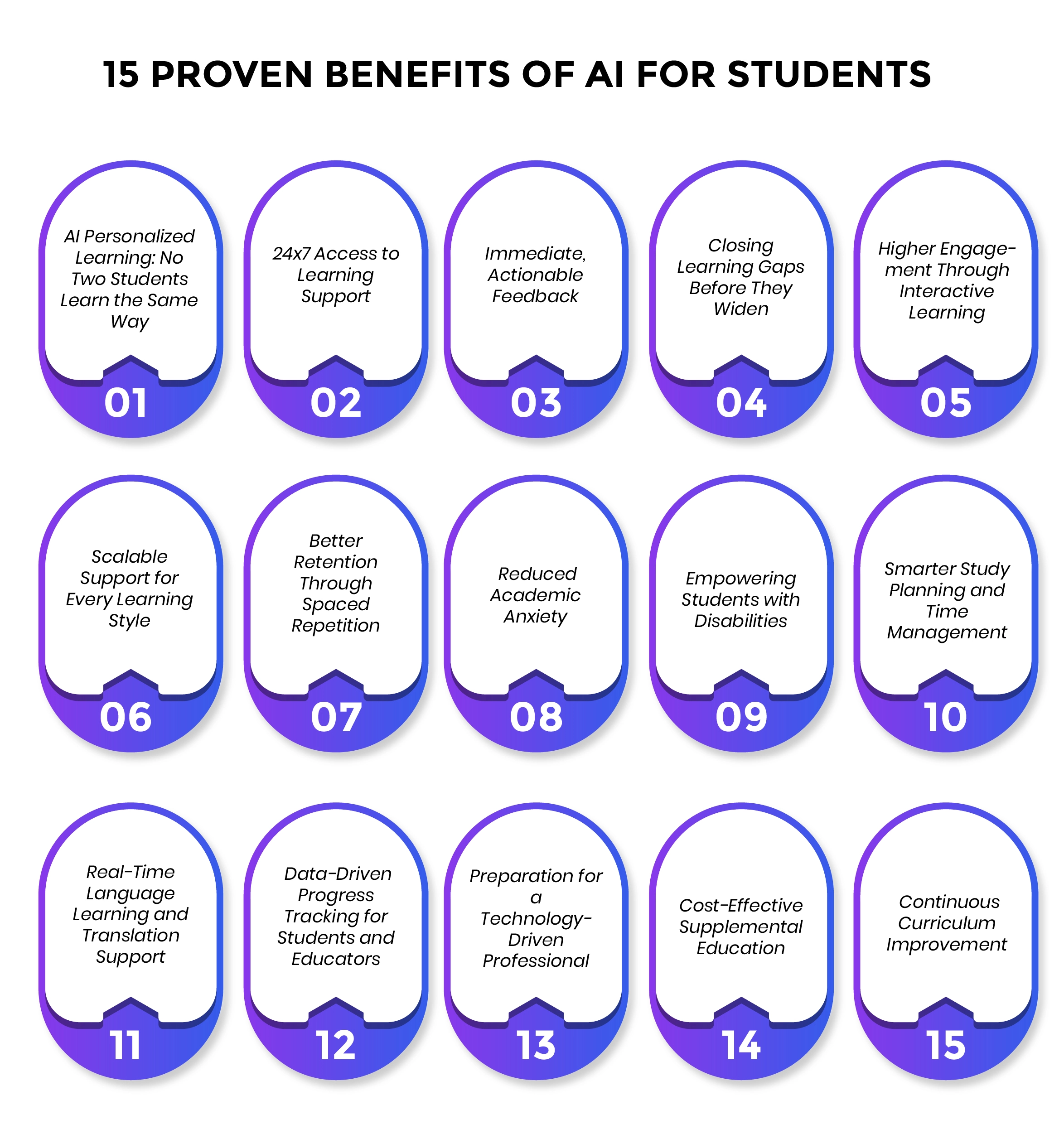
1. AI Personalized Learning: No Two Students Learn the Same Way
Here’s a basic fact that many conventional education systems don’t consider: each student is unique. Different pace. Different strengths. Different memory styles. Yet, for a long time, schools have been using a uniform approach to teaching.
Using AI for individualized learning is a great way to break away from this standard. By looking at the learners’ individual performance data instantaneously, AI systems modify the way content is presented, the level of difficulty, and the speed of learning to match each person.
Tools like Carnegie Learning and Khanmigo (Khan Academy’s AI tutor) are examples of this being done on a large scale. For instance, a student who has a strong grasp of reading comprehension but is a bit slow in algebra will get more algebra exercises – and this happens automatically, without the student even having to let the teacher know about it.
“Personalization at scale” is no longer a marketing phrase. It is the core promise of AI in student learning – and it is being delivered.
2. 24x7 Access to Learning Support
It is 11:47 PM. Your exam is tomorrow at 8 AM. You are stuck on a concept and your teacher is very probably asleep. This is precisely when AI for students turns out to be really revolutionary. AI tutoring is not just a human tutor – it is a super human assistant.
They do not have breaks or holidays and you can study with them anytime you want. You will get your learning materials with the aid of explanatory video clips, step-by-step guided answers, and examples.
What a great thing that is that one of the biggest problems in education is the lack of the availability of a teacher or a tutor who can help you outside school hours. Now that problem is solved to a large extent.
- AI tutors respond instantly, at any hour
- Students in remote areas gain the same access as those in well-funded districts
- The playing field levels – significantly
3. Immediate, Actionable Feedback
Typically, students will get their work back with a grade and maybe a few margin comments after some days, by which time they have already moved forward. This method doesn’t help students to learn better; it merely tells the result of learning.
AI completely reshapes the feedback cycle. Students are given immediate reactions to their work they get not only the mark but also detailed feedback on their errors and explanations. This is highly significant.
Studies conducted by the education platform Formative reveal that students who get instant feedback show 20-30% better concept retention than those whose feedback is delayed.
A study by the Bill & Melinda Gates Foundation found that formative assessment with rapid feedback loops improves student learning outcomes by up to 25%.
With AI, that feedback cycle compresses from days to seconds. And that changes everything about how students learn from their own errors.
4. Closing Learning Gaps Before They Widen
A student in a traditional class who doesn’t grasp a fundamental concept in October is likely to be so lost by December that they will have given up completely in March.
AI in student learning recognizes those gaps immediately and fixes them without the students even realizing. By examining the pattern of a student’s answers, AI programs indicate the spots where comprehension is lacking and then focus the student on those areas. It is not a response but a prediction.
The system detects a problem even before it results in a pattern. Such an early help is one of the most valuable AI benefits in education at the school level.
5. Higher Engagement Through Interactive Learning
Boredom has been a major enemy of education for a very long time. These days, with use of technology, teachers are getting that students change the way they learn, so “the passive” long lectures, reading, and monotonous exercises are the ones that demotivate students the most. Luckily, AI-powered learning platforms can engage students and bring them the interactivity they want by generating adaptive quizzes, mimicking a real-life human tutor in a chat, gamifying the progress of students, or showing them real-like, scenario-based simulations – all of that making the students feel that their learning environment is always changing and not the same old, boring one.
Duolingo, for example, uses AI-driven gamification to maintain user streaks and optimize lesson difficulty. The result? An average of 34 minutes of daily active learning per user — significantly more than most traditional classroom sessions.
- Interactive formats increase time-on-task
- Gamified elements reward progress, sustaining motivation
- Students actively participate rather than passively absorb
6. Scalable Support for Every Learning Style
Visual learner? AI generates diagrams and infographics. Auditory learner? Text-to-speech and voice-based tutors are built in. Prefer to learn by doing? Simulations and interactive problem sets. Prefer reading and writing? Structured breakdowns with detailed explanations.
AI for personalized learning does not force students into a single mode. It adapts to how each person actually processes and retains information — an advantage no single human teacher can realistically deliver across a class of 30.
7. Better Retention Through Spaced Repetition
Cognitive science has known for decades that spacing out review sessions dramatically improves long-term memory retention. The problem was always implementation — tracking what each student needs to review and when.
AI automates this completely. Anki (AI-enhanced) and Quizlet’s Q-Chat are just two examples of platforms using spaced repetition algorithms to identify the right content for the learners at the right time. Learning material is reviewed by students during the optimal forgetting period which is just the right time before the brain would forget the information. This method leads to actual long-term retention as opposed to mere short-term test performance. This difference is of utmost importance for students who will require the knowledge acquired not only for passing the exam but for their entire life.
8. Reduced Academic Anxiety
Asking a question in class carries a social cost. Students fear judgment. They worry about looking slow. Many stay silent rather than admit confusion and fall further behind as a result.
AI tutors remove that social friction entirely. There is no shame in raising the same question ten times, for instance, before a student. There is no need for them to hesitate to follow their curiosity and inquire about a topic from all possible angles if they only think about their own learning process and not the other people’s time.
In this way, psychological safety is a good point of AI for students that is hardly mentioned. Removing the fear of being criticized allows curiosity to flourish. Consequently, the students take part in the learning process more intensely, since to a certain extent it is an enjoyable experience, with no pressure.
“AI is not judging you. It is not sighing. It is not checking its watch. It is just teaching – endlessly, patiently, at your pace.”
9. Empowering Students with Disabilities
One of the most revolutionary impacts of AI in student learning has been the way it has radically changed the abilities of students with disabilities, individuals whom the conventional school systems have regularly failed in their educational needs.
- Text-to-speech and speech-to-text tools support students with dyslexia and reading differences
- AI-powered captioning assists students with hearing impairments in real time
- Adaptive interfaces adjust visual elements for students with vision challenges
- Predictive text and grammar tools support students with writing difficulties
These are not niche features. They are core accessibility benefits that expand educational participation for millions of students globally.
UNESCO estimates that 240 million children globally live with a disability. AI-powered accessibility tools are among the most scalable interventions available to expand their educational access.
10. Smarter Study Planning and Time Management
Most students do not fail because they are incapable. They fail because they do not know how to manage their time across multiple subjects, deadlines, and commitments.
AI tools now help students build optimized study schedules based on their academic goals, upcoming assessments, and current knowledge gaps. Platforms analyze what a student knows, what they need to know, and how much time they have — then build a plan accordingly.
This is not generic advice. It is dynamic, data-driven guidance that adapts as the student’s situation changes. Missed a study session? The AI recalibrates. Nailed a difficult topic? It moves on. That level of responsiveness is one of the most practical benefits of AI for students in busy academic environments.
11. Real-Time Language Learning and Translation Support
For non-native speakers, traditional education presents a compounding challenge: learning the subject matter while simultaneously navigating language barriers.
AI-powered translation, language simplification, and multilingual tutoring tools address this directly. Students can access explanations in their native language, receive translated content without losing academic accuracy, and practice language skills in context — simultaneously advancing both language and subject proficiency.
This benefit extends far beyond ESL students. It supports international programs, exchange students, and multilingual households where academic support in a second language is limited.
12. Data-Driven Progress Tracking for Students and Educators
One of the most underappreciated benefits of AI for students is the quality of the data it generates not just for the AI system, but for teachers, parents, and students themselves.
AI platforms produce detailed learning analytics: time spent on each topic, accuracy rates by concept, improvement trajectories, and projected performance on upcoming assessments. This transforms vague impressions of student progress into precise, actionable intelligence.
- Teachers can identify which students need additional support
- Parents receive meaningful updates on their child’s academic development
- Students gain self-awareness about where their time and energy is best directed
Informed learners make better decisions. And better decisions lead to better outcomes.
13. Preparation for a Technology-Driven Professional World
Here is the long game. Not only are students who use AI tools today achieving great results, they are also acquiring digital fluency which help them throughout their entire careers. For example, the mastery of AI-assisted research, AI-based analysis tools, and data-driven decision making is fast becoming a standard expectation in professional settings. Moreover, students who prepare themselves with the help of such tools while they are still studying will have a considerable advantage once they enter the employment market.
According to the World Economic Forum’s Future of Jobs Report 2023, AI and machine learning roles are among the fastest growing globally – with 40% of core skills expected to change within five years.
AI in student learning is not just academic preparation. It is professional preparation.
14. Cost-Effective Supplemental Education
Tutoring of high quality has long been a luxury. Engaging a private tutor in a big city might set you back $80 to $150 per hour. For a lot of households, it just isn’t doable. AI-assisted tutoring systems deliver similar and in some aspects, better educational help to learners at a tiny fraction of the price.
A number of well-regarded platforms even offer freemium models, hence making them available to different income groups. This opening up of learning assistance is probably the most socially impactful way that AI is benefiting students. It doesn’t undo educational inequality, but it significantly reduces the gap.
15. Continuous Curriculum Improvement
AI does not just benefit students – it makes educational content better over time. Since AI platforms gather aggregated and anonymized data about student responses to various kinds of content, explanations, and problem structures, they rely on that information to update and enhance their curricula.
A concept that students consistently find confusing gets a new explanation approach. A format that drives high engagement gets expanded. This continuous optimization is something no static textbook can offer.
The result: educational content that improves with use, rather than becoming outdated. That is a fundamental shift in how learning materials evolve and it benefits every student on the platform.
AI vs. Traditional Learning: A Quick Comparison
Feature | Traditional Learning | AI Personalized Learning |
Pacing | Fixed schedule for all | Adapts to each student |
Feedback | Delayed (days/weeks) | Immediate and specific |
Availability | School hours only | 24/7 access |
Personalization | Limited | Fully individualized |
Cost of extra support | High (private tutors) | Low to free |
Progress tracking | Manual and infrequent | Continuous and automated |
Learning styles | Primarily one-size-fits-all | Multi-modal and adaptive |
Key Takeaways
Before wrapping up, here is a concise summary of what you need to carry forward:
- AI for personalized learning changes according to each student’s pace, way of learning, and what they require; the two experiences can’t be the same.
- The advantages of AI for students include academic success, mental health, equality, and career readiness.
- AI for students’ learning is not a substitute for teachers; it can significantly increase their effectiveness.
- Students with disabilities get millions of doors of education opened for them by good features of accessibility in the AI tools.
- One of the biggest changes in education in a generation is the advent of AI as a tool to make quality learning support available to every student.
Conclusion
The discussion of AI in education has moved past “if.” Now, it is a matter of “how effectively” and “how quickly.” The 15 advantages mentioned in this post are openings for a shift, which is actually happening. Through interaction with AI for personalized learning students of today are not merely going along with the flow of a trend, they are equipping themselves with capabilities, habits, and academic foundations that will keep them productive for decades. The message to educators is just as strong: AI will not lessen your role at all. Rather, it will enhance it. While you concentrate on those things that only a human can do (e.g. inspiration, mentoring, providing context, and making connections), AI can be the one that takes the load of doing the same repetitive, everyday, and logistical tasks. If we are talking about institutions that are contemplating how to invest in their students’ futures, they would find that the data, the research, and the outcomes in the world are all indicating one and the same way.
Personalized learning through AI will not be the future of education. It is already the present and the students that are being supported by it right now are already the ones who are ahead.
FAQs
1. What is AI personalized learning, and how does it work?
AI personalized learning means the systems that help to improve education with artificial intelligence by personalizing the content, rhythm, and mode of the teaching methods to fit a particular student. Instead of giving the same material to all students at the same time, these systems monitor the learner’s answers, the way they normally perform, and level of interest live. They change the following lesson, the way it is taught and the number of times it is revised after the evaluation making a truly personalized learning path for each individual.
2. Are AI tools in education safe for younger students?
Reliable AI-based education platforms view student safety as a basic essential. To earn the trust of their users and that of their parents, they conform to legal requirements such as the US COPPA (Children’s Online Privacy Protection Act) and the European GDPR. Most platforms that are intended for young learners lead the students emotionally, intellectually and socially, as well as with the language of their bodies, interact in safe, closed, and supervised spaces where they are not exposed to age-inappropriate content, do not collect excessive personal information, and limit the exposure to external content. However, before trusting and purchasing any platform, teachers and parents should read and interpret the platform’s privacy policy and terms of use. Meanwhile, the top AI education platforms have elevated the implementation of safety measures to a fundamental aspect of their product rather than merely an afterthought.
3. Does AI in student learning replace human teachers?
Not at all and this difference is really significant. The AI tools can take care of the planning and execution parts of the content: lesson delivery, grading the provision of feedback limited to the structured tasks, and the adjustment of the content. However, the human connection, motivation, and the contextual functions of a great teacher are the ones that cannot be mimicked by AI. A teacher involves judgment, empathy, cultural sensitivity, and the capability to motivate. AI extends a teacher’s capacity and efficiency but it is not a replacement for their presence or skills. Current best educational settings integrate both.
4. Can AI help students who already perform well academically?
Definitely. Artificial Intelligence can be a powerful tool for individualizing education and can support the learning of students from all academic levels. For example, high-achieving students are usually not sufficiently challenged in regular classrooms as they most of the time have to go over the same content that they have already understood while just waiting for the others to catch up. AI-based learning systems do away with such limitations by offering level-appropriate challenges to students who have mastered certain things. Not only do advanced students have enough time to check out untried concepts and get readings richer in content, but also they can be working on their thinking skills of higher levels along the lines of their ability through AI, which does not hold any student according to a time schedule designed for the average one.
5. How do institutions evaluate which AI learning platform is right for their students?
Institutions evaluating AI-based learning platforms should judge these platforms against a number of factors including how well they align with the curriculum, the quality and explain ability of the adaptive algorithms used, provisions for students with disabilities, data privacy, the possibility of integrating the system with current learning management systems, and demonstration of tangible learning outcomes. Implementation of pilot programs with success criteria is highly encouraged as a step towards full roll-out. Teachers get a chance to offer their views on selecting the platform too nothing can replace their firsthand knowledge of students’ needs when determining whether a platform will really bring value in a practical sense.