


- Introduction
- 1. Set Up Your Study Environment Before You Open a Single Book
- 2. Use the Pomodoro Technique to Stay Focused for Long Hours
- 3. Master the Art of Active Learning
- 4. How AI Study Tools Are Changing the Game
- 5. AI Faculty: How Professors and Educators Are Using AI to Teach Better
- 6. How to Stay Focused During Long Study Sessions: 5 Proven Ways That Work
- 7. Sleep: The Most Underrated Study Technique
- 8. Memory Techniques That Stick
- 9. Build a Consistent Study Routine (Not Just Study Sessions)
- 10. Know When to Switch Subjects
- 11. Track Progress and Reward Yourself
- Conclusion
- FAQs
So here’s the time you’re willing to sit for hours studying without your head exploding: if we’re honest. If it’s in practice, that is, you sit down to study on a given study session, it will go more like ‘sit at desk, open the book, pick up your phone, stare at the page for four minutes, order food you didn’t need’, than ‘sit at desk for hours without losing your mind’. And we’re not lazy.
You’re just not studying properly. Whether you are a student, a professional company worker, or a musician, the way you study is more significant than the number of hours you study.
Here’s your guide to the best study techniques, skills, and methods based on scientific evidence that will help you stay focused and feel like you remember more and study longer without burning yourself out.
We even shared how AI study tools are revolution rising student study in 2025 and beyond. HEPI Student Generative AI Survey: Usage of AI among university students increased from 66% in 2024 to 92% in 2025. Students’ approaches to studying have drastically changed.
1. Set Up Your Study Environment Before You Open a Single Book
Here’s something most people skip: the pre-study setup, or how to study setup and most importantly, how to study effectively for long hours. Your environment shapes your focus more than willpower ever will.
Think of it like this – a cluttered desk creates a cluttered mind. A noisy room kills concentration. The right setup can add hours of productive study time without you even noticing.
What a High-Performance Study Environment Looks Like:
- A dedicated study spot – not your bed, not your couch
- Good lighting (natural light is ideal, warm desk light works well too)
- Phone on silent or in another room
- A water bottle right there on your desk (keep hydrated and your brain sharp)
- Noise-cancelling headphones, or low-fi background music if sound is necessary
- Physical or electronic to-do list of what you’re going to cover.
Research from USAHS shows that simply switching up your study environment can improve recall performance. So if your home feels distracting, try a library, a quiet café, or a co-working space.
Pro Tip: The 5-Minute Rule
If you struggle to start, commit to studying for just 5 minutes. Once you begin, momentum takes over. Starting is always the hardest part – the rest usually takes care of itself.
2. Use the Pomodoro Technique to Stay Focused for Long Hours
The Pomodoro Technique is one of the most popular and successful studying methods. Created in the late 80’s by Francesco Cirillo, it breaks down long-term study into energized, even chunks.
How It Works:
- Study with full focus for 25 minutes
- Take a 5 minute break (stretch, walk, breathe – not social media)
- Repeat this cycle 3 – 4 times
- Take a longer 20 – 30 minute break after four cycles
This rhythm works because it respects your brain’s natural attention limits. Constant studying without breaks lowers cognitive ability, and you can skip the blocker road about thinking about how to study effectively for long hours.
Task-Driven Alternative to Pomodoro
Of course, not everyone does well with the same structure; if you get more out of your focus blocks of time, go for this: at the beginning of every study session, tell yourself, ‘Today I will spend 3 hours prepping for the SAT, ‘ and then take 15-minute breaks after every hour or so. Both work, though you’ve just got to do what sticks best!
3. Master the Art of Active Learning
Passive reading is the killer of retention. Reading 1 thing,ce then expecting to have learned it is like expecting to be fit by watching the workout videos.
You have to do something with it. Active learning is one of the best study methods for long study hours because this method engages your brain constantly, which results in less fatigue, and absorption takes place more.
Active Learning Methods That Work:
a) The Feynman Technique
Pick a concept. Make it a simple expression, so easy that a 12-year-oldcano better understand how to use it. Where you happen to stumble is where your weak area of information occurs. Restuck, to perfect those brief areas, and begin the process over again.
b) Mind Mapping
Instead of writing notes linearly, draw a mind map. Write your topic in the centre. Branch out with key ideas. Connect sub-concepts with lines. Studies have shown that a mind map can increase reading comprehension by allowing you to get an overview of the text and the relationships between ideas.
c) The Retrieval Practice Method
Close your notes and try to recall what you just studied from memory. This is harder than re-reading – and that’s exactly why it works. Retrieval practice is one of the most research-backed study methods available.
d) Spaced Repetition
Spaced practice – reviewing material at increasing intervals – is one of the most effective ways to study complex material. Apps like Anki are built on this principle. Instead of cramming, you review content on Day 1, Day 3, Day 7, and so on. Each review cements the memory deeper.
4. How AI Study Tools Are Changing the Game
How to study using AI is changing the way that millions of people are using AI tools. We’re no longer in a time of studying mindlessly by highlighting textbooks and wishing. Now, let’s discuss a tool that’s revolutionizing the studying for millions: artificial intelligence. This isn’t the time to use highlighters on pages and pray for that B.
AI study tools now offer personalized learning, instant concept explanations, smart flashcards, essay feedback, and adaptive quizzes – all in real time.
Key Stat: Almost 90% of students who use AI tools for studying say that they are more useful than a teacher. AI can also enhance the rate of increased knowledge retention by 30% among users.
Top AI Study Tools Worth Knowing:
- AI Faculty – Will act as your personal teaching assistant available anytime, anywhere.
- Studley AI – Designed specifically for long study sessions, it helps you plan sessions, summarize complex material, and quiz you in real time.
- Anki (with AI integrations) – Spaced repetition at its finest, now enhanced with AI-generated flashcards
- ChatGPT – Great for explaining difficult concepts in plain English or generating practice questions
- Notion AI – For building organized study notes and research documents
- Grammarly – Useful for professionals refining written summaries or reports
Why AI Tools Help You Stay Focused Longer
One of the biggest distractions during study sessions is friction – not knowing what to study next, struggling to understand a concept, or running out of practice material. AI tools remove that friction. You can generate a quiz instantly, get an explanation of a difficult formula, or have a dense research paper summarized in 30 seconds.
That means less time lost to frustration and more time actually learning.
Key Stat: A 2025 Harvard University physics study found that students using AI tutors learned more than twice as much in less time compared to those in traditional active-learning classrooms.
5. AI Faculty: How Professors and Educators Are Using AI to Teach Better
The AI shift in education is not just a student story. Faculty – professors, instructors, and other academic staff – already use artificial intelligence in their curriculum design, teaching, and in how they support their students.
This matters to you as a learner. When your educators use AI thoughtfully, the quality of what you receive improves. Better-designed lessons, faster feedback, and more personalised learning experiences are all direct benefits of AI-equipped faculty. About 40% of university administrators and 30% of instructors now use generative AI daily or weekly – up from just 2% and 4% respectively in early 2023.
About 40% of university administrators and 30% of instructors now use generative AI daily or weekly – up from just 2% and 4% respectively in early 2023.
AI Faculty – AI as a Teaching Assistant, Not a Replacement
The most effective faculty approach is exactly this: treat AI as a knowledgeable, always-available assistant – not an authority. Professors who are experts in their fields use AI to handle time-consuming administrative tasks and content generation so they can focus on what only humans do well: mentorship, nuanced feedback, and genuine relationship-building with students.
According to Derek Bruff, Associate Director of the University of Virginia’s Centre for Teaching Excellence, I’ve been using AI to help guide class discussions to the topics students really need to cover, rather than what the teacher planned on.
Using AI to undertake administration and content-creation activities boosts faculty task completion speed by over 25 %, according to a study from Harvard Business School. That’s time reclaimed for mentorship and meaningful instruction.
What This Means for Students Studying Long Hours
When faculty integrate AI tools well, students benefit in three key ways:
- Better-designed study materials – AI helps professors identify gaps in their curriculum and create clearer, more focused resources
- Faster feedback loops – Instead of waiting days for assignment feedback, AI-assisted grading support means students get constructive input sooner
- More accessible content – AI tools allow course materials to be adapted for different reading levels, languages, and learning styles without creating an extra burden for professors
The Honest Debate Around AI Faculty Use
It would be incomplete not to mention the ongoing conversation about where AI use by faculty crosses a line. The application of AI on a mass scale in wholesale grading- effectively in the absence of any authentic human review- has raised plausible and valid questions of individual fairness, personaliZation of services and quality of feedback.
Most of the prominent educators agree that AI should not serve as a shortcut, but a complementary tool. Instructors who implement AI to produce draft feedback and then tailor it themselves develop superior performance compared to educators who copy AI feedback entirely.
The technology amplifies good teaching – it does not substitute for it.
6. How to Stay Focused During Long Study Sessions: 5 Proven Ways That Work
Focus is not a personality trait – it’s a skill you build. And like any skill, the right techniques make all the difference.
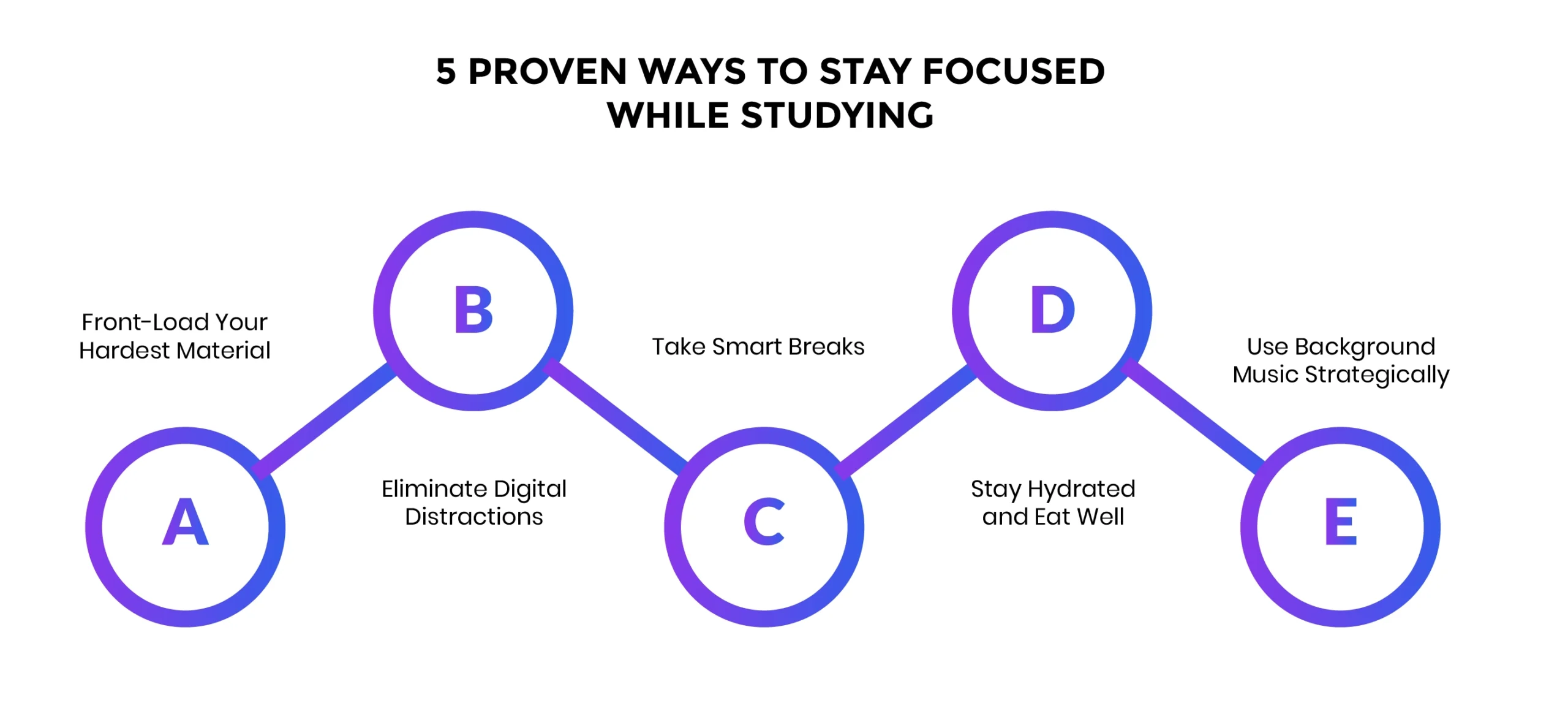
1. Front-Load Your Hardest Material
Schedule your brain’s peak time (morning or whenever you naturally feel awake and alert). Studies have shown that students who study more efficiently focus on more challenging topics at the beginning of their day. Save easier review tasks for when energy dips.
2. Eliminate Digital Distractions
Social media is made to be addictive- this isn’t a level playing field for your willpower. Use apps like Forest, Cold Turkey, or Freedom to block out websites and operating systems while you’re using your study blocks, or even turn your phone face down across the room. The distraction of unnecessary social media apps foes raise a question of how to stay focused!
3. Take Smart Breaks
At breaks, don’t do anything that overfires your brain. Scrolling through Twitter or Instagram, an hour-long FPS game, or short-form YouTube/ TikTok videos will re-route your attention … in the wrong direction. Do: stretch, go for a quick walk, sip water or do some light breathing.
4. Stay Hydrated and Eat Well
Your brain is an organ and not a hamster. It needs to be fed. Dehydration can lead to feeling tired, grumpy and making mistakes – all bad when you’re studying. Buy a bottle of water, try not to fill up on the sugar crash of rubbish food.
5. Use Background Music Strategically
Playing instrumental music, lo-fi beats, or ambient noise reduces distractions as easily as creating distracting ones. Words in music will make it difficult to read and write. Listen to binaural beats, or play classical music on a playlist.
7. Sleep: The Most Underrated Study Technique
Here is the highest truth. achievers overlook: studying all night long is probably the last thing you should be doing if you want to learn. This can basically reduce your queries on how to stay focused.
While you sleep, your brain is working to stabilise memories.
During deep sleep, the information learned that day is relayed into long-term storage instead of short-term. If you don’t sleep, this process is almost impossible.
A 2019 study published in peer-reviewed research found a positive relationship between students’ grades and consistent, adequate sleep – particularly getting enough sleep in the nights before the primary study period, not just the night before an exam.
Sleep Rules for Effective Studying:
- Aim for 7-8 hours of sleep on study nights. Prioritise sleep consistency – same bedtime each night
- Avoid screens for 30–60 minutes before bed
- Have brief 1020-minute naps when mentally tired mid-day (they bolster concentration without distorting sleep).
- Take a short 10-20 minute nap if you get mentally tired in the middle of your day (they refresh your concentration without affecting your sleep at night)
8. Memory Techniques That Stick
Raw repetition is inefficient. The brain remembers things that are different, emotional, visual, or connected to what it already knows. These memory techniques exploit exactly that.
Top Memory Techniques for Long Study Sessions:
- Mnemonics
Come up with abbreviations, rhymes, or associations to help you memorize lists, etc. The more bizarre or outlandish the phrase, the easier it will be to recall. - The Memory Palace (Method of Loci)
Imagine a well-known location – your house, your university. Imagine sitting the pieces of information you require all around this location. When you need them, then mentally walk through the location. This age-old technique of memory is still one of the most effective there is. - Chunking
Package related bits of information into ‘chunks’. Rather than memorizing the 12 digits as separate digits, group them into four groups of four digits. The brain can then process chunks far more easily. - Teach to Remember
The best way to learn is to teach – even an imaginary listener. When you have to clarify a concept to another person, your knowledge becomes mapped out and well-structured, and at the same time, you fill in gaps.
9. Build a Consistent Study Routine (Not Just Study Sessions)
One-off marathon study sessions fail to establish long-term knowledge. Regularity does.
Stick to a study schedule of weeks, not days, days before a deadline. Numerous studies indicate that distributed study over time results in much stronger retention than massed practice.
How to Build a Study Routine That Lasts:
- Identify your peak focus hours and protect them for study
- Set weekly learning goals, not just daily task lists
- Review material from the previous session before starting new content
- Use a planner – physical or digital – to schedule and track study blocks
- Reward yourself after completing sessions to reinforce the habit
An actionable strategy: dedicate yourself to a 90-day study sprint. Accumulate a steady momentum for three months, and the study will then seem effortless.
10. Know When to Switch Subjects
Studying one subject for 6 hours straight is not deep work – it’s monotony. Interleaving different subjects keeps your brain engaged and actually improves learning outcomes.
Research published in the National Institutes of Health (NCBI) supports mixing subject study with regular consolidation periods. Try studying two or three related (but distinct) subjects in a single day, rotating between them after focused blocks.
A Sample 8-Hour Study Day:
Time Block | Activity | Focus Level |
8:00 – 9:30 AM | Subject A – Hardest Topic (Pomodoro x3) | High |
9:30 – 10:00 AM | Break + Light Walk | Rest |
10:00 – 11:30 AM | Subject B – Practice Questions | High |
11:30 AM – 12:00 PM | Review + Mind Map Session A | Medium |
12:00 – 1:00 PM | Lunch Break | Rest |
1:00 – 2:30 PM | Subject C – New Concept + Flashcards | High |
2:30 – 3:00 PM | Break + Hydration | Rest |
3:00 – 4:30 PM | Subject A – Retrieval Practice | Medium |
4:30 – 5:00 PM | Wrap-Up + Next Day Planning | Low |
11. Track Progress and Reward Yourself
What gets monitored gets managed. Monitoring your studying doesn’t only help you manage your time better – it also increases motivation and gives you a real sense of accomplishment.
Simple Ways to Track Study Progress:
- Use a habit tracker app or a simple paper log
- Record how many Pomodoro sessions you complete each day
- Note which topics you’ve covered and which need more review
- Set weekly milestones and check them off visibly
The Role of Rewards
Rewarding good study habits builds positive reinforcement. After completing a productive session, do something you enjoy – watch an episode, take a longer walk, call a friend. Small, genuine rewards make long-term consistency feel sustainable, not punishing.
Conclusion: Study Smarter, Go Further
Here’s the big takeaway: studying for long hours is possible, productive, and even energising – when you have the right techniques in place.
The best study techniques are not about grinding harder. They’re about working in harmony with how your brain actually functions. Structured focus sessions. Active engagement with material. Smart breaks. Proper sleep. The intelligent utilization of AI study assistants, which enhances the speed and efficiency of the learning process. No matter who you are, what you’re doing (Final exams? Certification? Self-education?), these techniques are for you. Pick one or two that you feel comfortable implementing right away, then add in more as time goes along. Strength overcomes strength any day!
Now close the 14 browser tabs you have open, set a 25-minute timer, and get started. Your future self will appreciate it.
FAQs
1. What is the most effective study technique for long hours?
In the long run, the most effective studying methods to find are the Pomodoro Technique, alongside active learning 3 efficient techniques of active retrieval, such as spaced repetition or retrieval practice. Since these methods ensure you remain vigilant, they maximise knowledge retention without overloading you. Quality beats quantity, any day. As you gain stamina, you can gradually increase the duration of your productive period.
2. How can AI study tools help me stay focused while studying?
AI study tools help to overcome the friction that kills fresh focus for overly long study sessions. Quality over quantity will always triumph over quantity. When your stamina improves, you can extend the length of this productive period.
3. How many hours of studying per day is realistic?
For many individuals, ls continuous purposeful 3-5 hours a day of study beats 8-10 hours of variable drifting unindexed study. Quality beats quantity, any day. As you gain stamina, you can gradually increase the duration of your productive period.
4. Is it better to study in the morning or at night?
It really depends on your natural rhythm. Most studies support studying hard material in the morning when you are well rested because your thinking is better. However, some people are wired for working late at night and are more focused in the evening. First, you must find those hours out.
5. How do I avoid losing focus when studying for long hours?
Focus. Use focused blocks of time separated by breaks, proactively eliminate digital temptations, remember to drink water, use topic rotation to stimulate your brain, and keep an eye on the amount of effort you’re putting in to stay accountable.
6. Can AI replace traditional study methods?
AI study tools serve as an enormous boost to your existing methods. Having an AI as a study buddy is super helpful, but it’s not a substitute; it slots right in with good study methods such as spaced repetition, active recall, mind-mapping and the like.