


You sit down at your desk. Your notes are open. Your coffee is hot. And your brain? Completely blank. Sound familiar? You are not alone. Millions of students – and yes, even busy professionals – spend hours “studying” without actually retaining anything meaningful. The real issue is not effort. It is a method. The good news is this: science has cracked the code on how humans actually learn. And once you apply the right methods of learning, everything changes – from how long you retain information to how confidently you walk into a test, presentation, or boardroom.
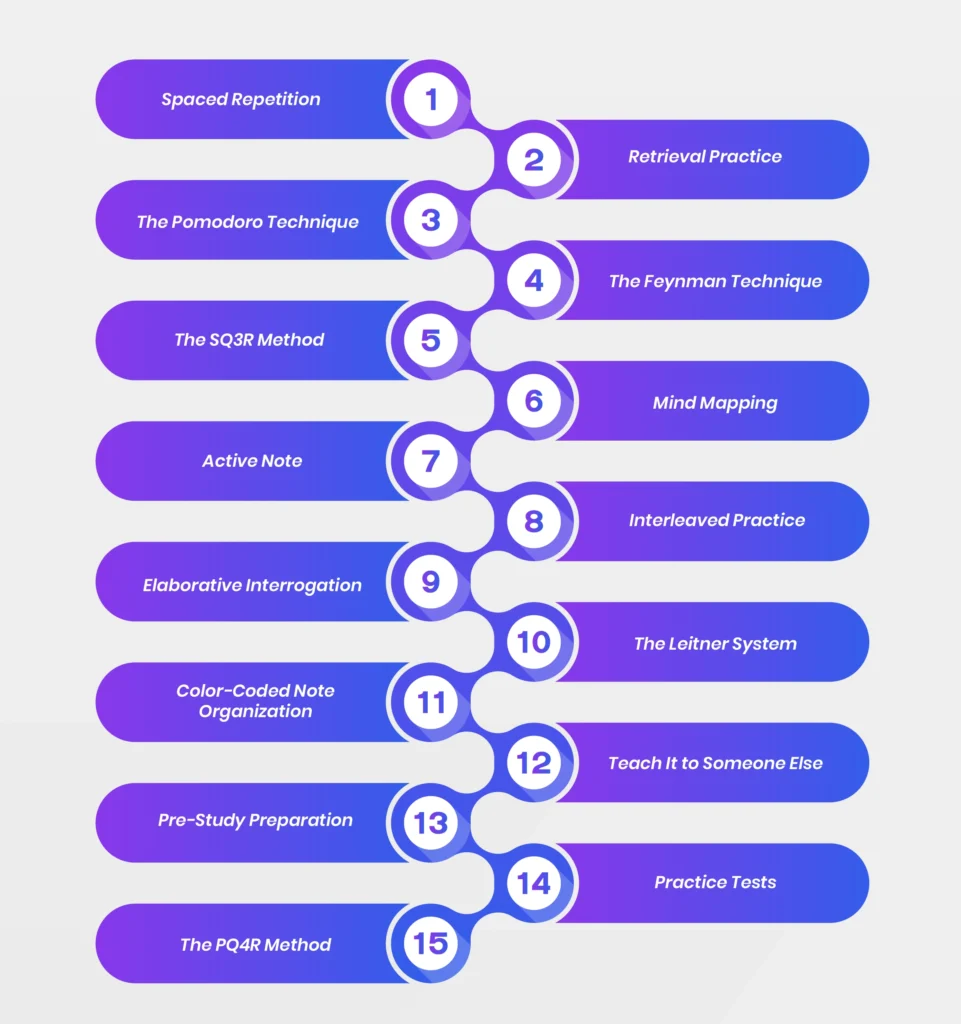
This article walks you through 15 of the best study techniques, backed by research and practical enough for students, professionals, and lifelong learners alike. No fluff. No filler. Just what works.
Why Most People Study the Wrong Way
Here is a hard truth for you: one of the least productive study methods ever found is re-reading your notes. However, it is still the default method for most students.
A major research conducted by Psychological Science in the Public Interest examined ten ordinary learning methods and concluded that highlighting, re-reading, and summarizing were among the weakest methods.
On the other hand, retrieval practice and spaced repetition were always at the top of the list.
According to the research done by the Department of Psychology at UC San Diego, the top two methods that have proven to be the most effective are spaced practice and retrieval practice, yet most students do not make a conscious effort to use either of these methods. Just imagine your brain as a muscle. Passive exposure does not build it. Active recall does.
15 Best Study Techniques to Transform Your Learning
1. Spaced Repetition - Study Smarter, Not Harder
Spaced repetition stands out as the most strongly supported study method by scientific evidence at present. Instead of getting up late and studying by going over the material for hours in one sitting, you allocate your study time over several days or weeks, revisiting the content after gradually increasing intervals just before you would usually forget it.
Why it works: Every time the brain successfully recalls information, it is strengthening and deepening the memory in turn. A research paper in Cureus (2022) suggested that spacing out practice sessions, as compared to cramming study sessions, can result in not only more efficient but also longer-lasting learning across ages and various subject matters.
How to apply it:
- Review new material within 24 hours of learning it
- Review again after 3 days, then 7 days, then 21 days
- Use apps like Anki or Quizlet to automate the scheduling
Fun fact: The fact is, over 200 research studies spanning almost 100 years have documented the benefits of spaced practice in helping students remember information for a longer period of time as compared to the one-time, lengthy cramming session.
2. Retrieval Practice - Test Yourself Before the Test Tests You
Retrieval practice involves actively retrieving information from memory as opposed to just rereading it without interacting deeply. So if you normally look over your notes, with this method, after closing the book, you try to write down all that has remained with you. Then you check your notes and fill in the gaps.
Cornell University’s Learning Strategies Center refers to this method as “Blank Page Testing” – you begin with a blank sheet and rely solely on your memory to construct your answer. It is a rather uneasy feeling. However, that uneasiness is precisely what makes the method so powerful.
How to apply it:
- After reading a chapter, close it and write a summary from memory
- Use flashcards with answers hidden
- Take practice tests without looking at the material first
- Quiz yourself or study partners on the key concepts
3. The Pomodoro Technique - Structured Focus Beats Marathon Sessions
Named after a tomato-shaped kitchen timer (pomodoro is Italian for tomato), this method divides study time into focused 25-minute blocks separated by 5-minute breaks.
After four consecutive blocks, you take a longer 15-30 minute break.
Why it works: Our brain functions in ultradian rhythms that regularly cycle through periods of concentration and relaxation. Instead of battling them, the Pomodoro Technique matches your study time sessions with these rhythms.
How to apply it:
- Set a timer for 25 minutes
- Work on ONE task only during that time
- Take a 5-minute break (stand, stretch, hydrate – do not scroll)
- Repeat four times, then take a longer break
Bonus tip: Silence notifications completely during each block. Your focus window is sacred.
4. The Feynman Technique - If You Cannot Explain It Simply, You Do Not Know It
Explaining physics to a kid, and that’s how Feynman saw true knowledge – no fluff, just clarity.
As it happens, he used this method often, even when teaching at the highest levels. The trick starts with picking a topic and simplifying it so a child could grasp it instantly.
The process is straightforward:
- Choose a concept you want to learn
- Write it down as if you are explaining it to a 12-year-old
- Identify gaps in your explanation
- Go back to your source material, fill those gaps, and simplify further
Why it works: Simplifying means that you will have to connect with the essence of the ideas. It is impossible to pretend with simple language. Basically, it is a matter of either knowing the concept or not. One can encounter subjects such as economics, programming, chemistry, or marketing strategy that are deeply complicated and involve a lot of abstraction.
To understand them is the essence of the work that this method is capable of delivering very effectively.
5. The SQ3R Method - A Structured Way to Read and Retain
SQ3R stands for Survey, Question Read Recite, Review are the words that the acronym SQ3R stands for. The use of SQ3R remains one of the most popular study guide & strategy for digesting a piece of heavy academic or professional reading.
Here is how it works:
Step | Action |
Survey | Skim headings, subheadings, and captions to preview the content |
Question | Turn each heading into a question (e.g., “What is retrieval practice?”) |
Read | Read actively to answer your questions |
Recite | Pause and answer the question from memory after each section |
Review | At the end, summarize the entire chapter from memory |
SQ3R turns reading, even if it’s just skimming, into a step-by-step, detailed work. In fact, it is the reason why this method of study is included among the top study techniques.
6. Mind Mapping - Visualize Your Knowledge
Mind mapping is a visual style of learning, where you interconnect ideas around a central topic, quite similar to branches of a tree. Rather than writing linear notes, you put the main subject at the center and spread out with subtopics, details, and links.
Why it works: The brain digests visual data way faster than it reads or understands text. Mind maps not only stimulate the logical side of our brain, but they also activate the creative side. Hence, both understanding and memory can be improved.
Best for: Idea generation, exploration of interrelated concepts, composition planning, or execution of a project, and preparing for an examination by making a summary of a topic which is difficultt. For this technique, you can use Mind Meister, XMind, or simply a blank sheet of paper.
7. Active Note-Taking with the Cornell Method
The Cornell Method divides your note page into three sections:
- Right column (large): Notes taken during class or reading
- Left column (narrow): Key questions or cues added after class
- Bottom section: A brief summary written in your own words
This format naturally encourages retrieval practice, because you cover the right column and use the left-column cues to test your recall.
A graduate-level study tip from the University of the Sciences in Health Professions notes that messy, passive notes make recall extremely difficult and that writing in color or using visual organization dramatically improves retention.
8. Interleaved Practice - Mix It Up on Purpose
Most students study one topic at a time – all algebra, then all geometry, then all calculus. This is called blocked practice.
Interleaved practice turns this idea on its head. You don’t focus on one single topic, but instead you mix different problem types or topics during one study session – algebra, then geometry, then calculus, and finally back to algebra.
Why it works: The study quoted in the Apex Tuition Australia review of study science mentions that students who do interleaved practice do much better when they have to apply their knowledge to new and unfamiliar problems.
A varied exposure is what helps in building cognitive flexibility. It is the fact that it seems more difficult at the time that actually, you are learning the most deeply.
9. Elaborative Interrogation - Ask "Why" More Often
Instead of merely memorizing facts, elaborative interrogation is the process of coming up with explanations. Simply put, after each piece of information you study, you ask yourself,” Why? “
Example:
- Fact: “Spaced repetition improves memory retention.”
- Elaborative question: “Why does spacing out sessions improve memory?”
- Your answer: “Because each recall strengthens the neural pathway, and the brain allocates more importance to information it is asked to retrieve repeatedly.”
This deepens understanding and creates stronger memory hooks than rote memorization ever could.
10. The Leitner System - Flashcards That Adapt to Your Learning
The Leitner System is a very organized flashcard technique that employs spaced repetition. It is indeed one of the most effective methods of studying, especially for vocabulary definitions, formulas, or any factual type of learning.
How it works:
- Place all cards in Box 1
- Study daily: if you get a card right, move it to the next box; if wrong, return it to Box 1
- Each box represents a longer interval before you review it again
- Cards in Box 5 get reviewed the least frequently – you have already mastered them
This system ensures you spend the most time on what you know the least, – which is exactly the opposite of what most students do.
11. Color-Coded Note Organization
This technique is simple, effective, and woefully underused. Assigning specific colors to specific types of information (definitions, examples, key formulas, questions) creates a visual system your brain learns to recognize.
The University of the Sciences in Health Professions confirms that color-based organization is a dynamic, effective method of learning because it adds a second layer of association to every piece of information — the content AND the color.
Quick color-coding framework:
- Blue: Key definitions and terms
- Green: Examples or case studies
- Red: Warnings, exceptions, or commonly confused points
- Yellow (highlight): Items for urgent review
12. Teach It to Someone Else
Teachers have a very famous saying, “If you want to learn something well, then teach it.” Many students work on their own after class, but not all of them can understand the learning material so deeply. It takes a very strong helping relationship for the tutor and the student to get some of the best academic records. This would always be pointing to the reliable academic performance coming from the tutoring relationship.
You do not need to be a formal student. Explain concepts to a friend, a parent, or even record yourself teaching on video. The act of organizing your knowledge for an audience forces you to identify exactly where your understanding is solid and where it still needs work.
13. Pre-Study Preparation - Your Environment Shapes Your Output
Before you pick up a single book, your body and environment need to be set up for success.
Evidence-backed pre-study tips for students:
- Sleep: A 2019 study found a positive relationship between students’ grades and the amount of sleep they get. Aim for 7–9 hours before any high-stakes study session.
- Eliminate distractions: Studies consistently show that multitasking reduces productivity and comprehension simultaneously.
- Hydration: Even mild dehydration measurably reduces cognitive performance.
- Movement: Small doses of exercise right before studying help the prefrontal cortex (the brain area responsible for attention and decision making) get more blood.
You can consider pre-study “preparation” as a warm-up before a sprint. You wouldn’t run a race without warming up first, right?
14. Practice Tests - The Most Underused Study Tool
Actually taking a practice exam before you think you are prepared is one of the strongest learning aids and techniques scientifically proven to be effective.
Why it works: When you do a practice test, you are telling your brain to pull out, structure, and use the knowledge at the same time. Every time you try to remember, the memories get stronger,r and also when you realize what you don’t know right before the ex,m you get what to study figured out with a perfect map.
How to use practice tests effectively:
- Take the test without notes or textbook access (simulate real conditions)
- Grade yourself honestly
- Focus your next study session exclusively on the questions you got wrong
- Repeat at regular intervals using spaced repetition logic
According to research reviewed by UC San Diego, retrieval practice combined with spaced repetition is the most effective one-two punch in all of learning science.
15. The PQ4R Method - A Deeper Evolution of SQ3R
PQ4R stands for Preview, Question, Read, Reflect, Recite, Review.
This method adds to SQ3R by introducing a Reflect phase – a time when you associate new knowledge with your previous understanding, recognize how to use the information in real life, and analyze the text critically.
This technique is particularly valuable for professionals who must apply what they learn – not just pass a test on it. Marketing strategists, engineers, consultants, and executives benefit enormously from making reflection a structured part of their learning process.
Stat Spotlight: 6 Facts That Change How You Think About Studying
- Re-reading is nearly useless. Research published in Psychological Science in the Public Interest ranked re-reading among the least effective study strategies of ten common techniques evaluated.
- Spacing beats cramming every time. Over 200 studies confirm that spaced practice produces better long-term retention than any equivalent amount of massed study.
- Most students ignore the best methods. Research at UC San Diego found that many university students are unaware of — and rarely use — the most effective, evidence-based learning techniques.
- Tutoring produces a 2 Sigma advantage. Benjamin Bloom’s research showed that one-on-one tutored students perform two standard deviations above the class average — a staggering performance gap.
- Sleep directly impacts grades. This is because the amount and quality of sleep have a very strong influence on academic performance. One study in 2019 even discovered the existence of a measurable positive correlation between the main elements of sleep and the achievement of students in school.
- Interleaving beats blocked practice. In fact, mixed practice is superior to blocked practice in the experiments. The students who mixed different subjects in their study sessions significantly outperformed, mainly because they were tested on new problem types, not those they were prepared for in the study sessions.
A Practical Study Schedule Framework
You don’t have to implement all 15 techniques together. For starters, here is a framework that includes the major impactful methods:
Day | Activity |
Day 1 | Learn new material (active reading using SQ3R/PQ4R) |
Day 2 | Retrieval practice — blank page test on Day 1 material |
Day 4 | Flashcard review using the Leitner System |
Day 7 | Practice test or teach the concept to someone else |
Day 14 | Full review session + mind map to consolidate concepts |
Day 21 | Final spaced review before assessment |
This schedule takes no more than 30-45 minutes per session. Consistency beats marathon cramming, every single time.
How These Techniques Apply to Marketing Professionals
Here is a question worth asking: why does a marketing professional need to think about study techniques?
Because learning never stops in marketing. Algorithms change. Consumer behavior evolves. New platforms emerge quarterly. The professional who adopts effective methods of learning does not just keep up — they consistently lead.
The Feynman Technique breaks down complicated plans, so even someone without a tech background can grasp them.
Spaced repetition is where Teams use spaced repetition to lock in platform skills, product specs, and data points instead of starting over each quarter.
Interleaved practice mirrors how real marketing work happens — across channels, campaigns, and metrics simultaneously.
Mind mapping is already widely used in campaign ideation and content strategy.
The best study techniques are not school-specific. They are human-specific. And the best marketers are relentless, strategic learners.
Conclusion
The truth is, your method of studying is much more important than the amount of time you spend studying. Great study methods like spaced repetition, retrieval practice, the Feynman Technique, interleaving, and active note systems, etc. have one major thing in common. They require your brain to work, not just observe.
Each of the methods mentioned in this article is supported by research, feasible to put into practice, and can be adapted to different levels, from a high school student studying for final exams, a university student taking a heavy load, to a working adult upgrading his/her skills in a rapidly changing environment.
You already have the time. The key to improving is finding the right ways of learning. Pick one from the methods below and commit to it for two weeks absolutely. Then see what changes.
The top effective learners are rarely the most talented ones. They simply are the most intentional ones.