
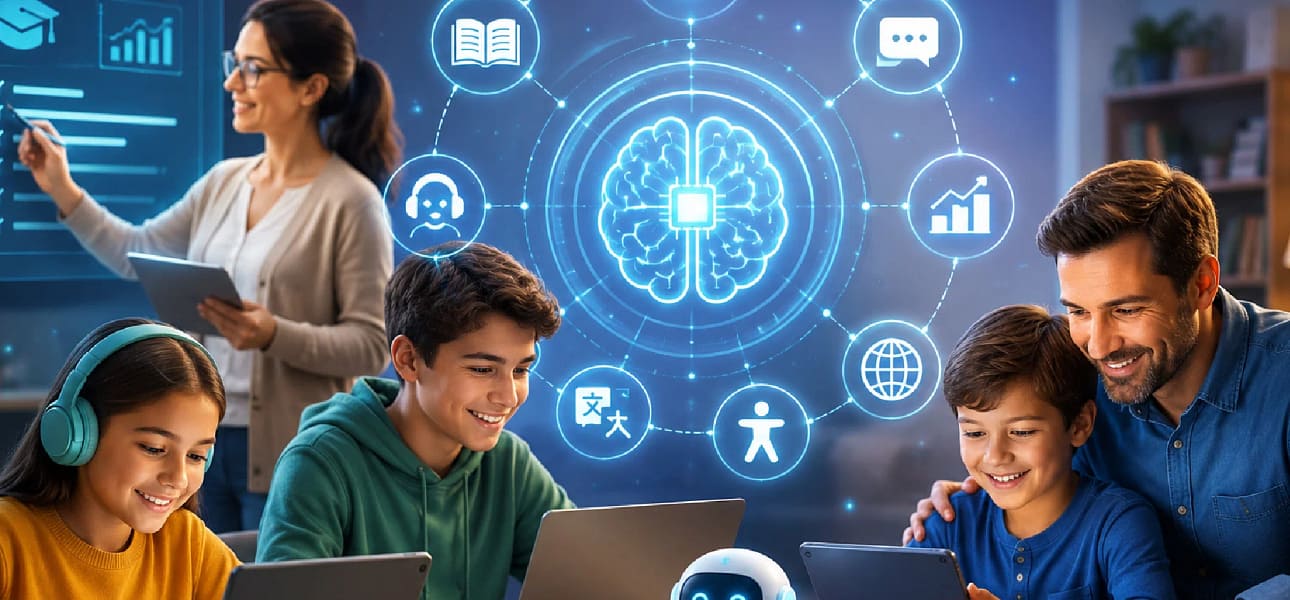

Education is changing fast. And the biggest driver of that change? Artificial intelligence. The advantages of AI in education are not some far-off fantasy; they are already taking place in classrooms, on laptops, and through various learning platforms that millions of people use every day.
If you are a student, finding ways to study more efficiently, a teacher dealing with a class of 30 different learners, or a parent trying to give your child every advantage, AI is, in fact, working for you. The real question is: are you using it to the fullest?
This article outlines the 10 main advantages of AI in education straightforwardly, engagingly, and backed with strong data for every point. No fluff. No filler. Just what you actually need to know.
Before diving into the benefits, here is a quick look at where the global education-AI space actually stands:
What Does AI in Education Actually Mean?
Implementing artificial intelligence in education means the use of AI tools such as machine learning, natural language processing, and data analysis to change learning and teaching methods.
Examples are:
- Smart tutoring systems that adapt the course to every student.
- System for automatic grading and giving feedback.
- Writing aids and research assistants powered by AI.
- Predictive analytic tools that can identify students who may struggle to keep up.
- Virtual classrooms and AI-driven content delivery.
Among the best AI educational tools for teachers are Khanmigo, Gradescope, and Turnitin’s AI capabilities. These technological innovations in education don’t have the purpose of replacing teachers or turning students into robots dependent on machines. They are designed to help produce a form of learning that is more effective, more human, and more equitable.
Top 10 Benefits of AI in Education (For Students, Teachers & Parents in 2026)
1. Personalized Learning for Every Student
Each student has unique learning preferences. For instance, one may understand math quickly but find reading difficult. Another one may rely heavily on visual learning but frustratingly lose concentration when reading texts. Traditional classroom scenarios cannot effectively address such diversity.
But AI makes a big difference.
AI-driven programs recognize a student’s learning style, what speed they like, the mistakes they keep making, and the kind of content they respond to. Based on this data, they alter the lessons instantly.
Imagine a helper who will never show signs of being tired, who will not get annoyed, and who at all times knows the exact point where you stopped.
One example is: Educational platforms similar to Khan Academy’s Khanmigo and DreamBox Learning change the level of the task as per the student’s past performance,e so that no one is left behind or gets bored. Ultimately, for students, this means fewer bewildering learning gaps. For parents, it translates to their child’s learning being well-timed, giving them a great sense of relief. And for teachers, it means every student arrives better prepared.
2. Smarter, Faster Feedback
One of the biggest gaps in traditional education is the feedback delay. A student submits an essay on Monday. They get feedback on Friday. By then, they have moved on – and the teachable moment is gone.
AI in education for students closes that gap dramatically.
AI software can analyze texts, identify grammar errors, assess whether the text flows logically, and even judge the content’s quality – all within seconds. When students make changes and communicate their progress, they are not delayed at all,l and, at the same time, their minds are still fresh with the lesson.
- Students receive rapid and precise feedback from educational platforms like Grammarly Business and Turnitin Feedback Studio.
- Mathematical applications like Photomath and Wolfram Alpha not only give answers but also explain the solutions step by step.
- Programs in the field of science present the results of experiments, either real or virtual, very fast.
Immediate feedback is not a substitute for a teacher. But it motivates students to work more regularly, it helps them to make fewer errors, and it speeds up the development of their skills.
3. AI in Education for Teachers: Reducing Administrative Burden
Ask any teacher what takes them the most time besides actual teaching. The answer is almost always grading, planning, data entry, and paperwork.
Studies show that teachers may devote up to half of their working hours to non-teaching duties. That is the time when they are not interacting with students, preparing interesting lessons, or helping learners in trouble.
AI in education for teachers is a direct solution to this problem.
AI Task | Time Saved Per Week |
Automated grading (MCQs, short answers) | 3–5 hours |
Lesson plan generation | 2–3 hours |
Progress report generation | 1–2 hours |
Parent communication drafts | 1 hour |
Attendance and data tracking | 1–2 hours |
That is potentially 8 to 13 hours per week given back to teachers. Time they can spend doing what they do best: teaching.
4. Accessible Learning for All
One of the strongest features and the most overlooked ones of AI in education is that it makes education accessible. Students with learning differences, such as dyslexia, ADHD, deafness, or blindness, are very often at a disadvantage because they have to use buildings and systems that were first and foremost designed with the majority in mind. AI is gradually changing this.
- Thanks to text-to-speech and speech-to-text tools, students with difficulties in reading or writing receive adequate assistance.
- Deaf and hard-of-hearing students find real-time captioning useful both in live and recorded class sessions.
- The AI translation tools are mostly useful for ESL (English as a Second Language) students who get to overcome language barriers.
Adaptive content is capable of either slowing down the pace or making the language easier based on comprehension cues. Emotion recognition systems can detect if a student is confused or uninterested. Education, that means, is not just a theory but a reality for all.
Every student – regardless of ability, language, or background – gets a fair shot. That is not just good for students. It is good for society.
5. Early Identification of At-Risk Students
In a classroom with 30 students, it is very easy for one student to quietly slip behind. The moment the difference is noticed, weeks of educational progress may already have been wasted.
AI-powered analytics transform this scenario by identifying the signs of trouble early – sometimes even before the teacher is aware.
How it functions: Drop in quiz scores, less participation, late submission of assignments, and even changes in the way students use a learning platform are the types of patterns that AI tools track. These signs pile up, and the program notifies the teacher to intervene in a timely manner.
Schools implementing predictive analytics have observed:
- As much as 25% of the gain in student retention
- Reduction in time for counselors and teachers to offer help
- Better doing and quicker interventions.
For parents, this is definitely one of the nicest features of AI in education. It shows that an AI assistant, like a teacher, is always monitoring your child’s development, including at times when you are absent.
6. Better Engagement Through Gamification and Interactive Content
Let us be honest: a 45-minute lecture is rarely anyone’s favorite part of the day. Students are not broken – they are just human. And humans learn better when they are engaged.
The use of AI-driven educational tools has transformed learning into something active, enjoyable, and intriguing.
- Duolingo employs AI to provide very short and gamified language lessons that feel like playing but actually help in learning the language really well.
- Minecraft Education Edition is an AI-driven platform where students can create, explore, and solve problems within digital settings.
- Kahoot and Quizizz utilize AI for generating quizzes that match the curriculum and competency level of the class.
One of the fantastic benefits of Virtual Reality (VR) learning, which is AI-enhanced, is that it can transport the students back to ancient Rome or take a tour inside the human body. Simply grabbing the students’ attention is not what they really need; their total and deep engagement is what truly impacts the level of their learning. Engaged students remember more, get involved more, and their results are also higher. AI makes that engagement scalable.
7. 24×7 Learning Support: The Always-On Tutor
It is 11 PM. Your child has a math test tomorrow and just hit a wall on fractions. Their teacher is not available. Their tutor is not picking up. And you have not touched long division since 1998.
This is exactly where AI in education for students becomes a genuine lifeline.
AI tutoring tools and chatbots are available 24 hours a day, 7 days a week. They do not get impatient. They do not judge. And they can explain the same concept 17 different ways until it clicks.
Leading AI tools in education for teachers and students in this space include:
- Khanmigo (Khan Academy) – an AI tutor that guides students through problems with Socratic questions
- Socratic by Google – uses AI to break down complex questions into understandable answers
- ChatGPT Edu – a custom AI environment designed specifically for educational institutions
- Coursera’s AI tools – help learners find the right course, track progress, and fill gaps in understanding
Round-the-clock support is not a luxury. For students in time zones different from their teachers, students with working parents, or students who simply need more time, it is essential.
8. Smarter Curriculum Design and Content Creation
Creating successful lesson plans involves more than just science; it’s a really skillful, creative, and well-informed process that calls for a deep understanding both of the subject and the learners. AI cannot substitute this skill – it can only help to develop it.
Teachers with the support of AI tools may:
- Draft different lesson plans catering to various student learning levels quite rapidly
- Create quiz banks, worksheets, and assessments that accurately reflect the curriculum standards
- Offer students extra materials fitting their learning abilities
- Change the original documents in several ways – text, audio,o video, interactive
- Detect educational system lags with an extensive study of student performance data
For school leaders and curriculum developers, AI offers something that is hardly ever available to them: a precise, data-driven picture of what is really effective – and what is not.
This type of insight enables curriculum design to be more efficient, precise, and well-targeted to the actual educational needs of the learners.
9. How AI Faculty Can Be Useful in Higher Education
One idea worth seriously considering is that of AI Faculty.
In simple terms, AI Faculty refers to AI-powered systems that are intelligent teaching assistants in educational institutions. They are not replacements for human teachers; rather, they are digital partners with which human teachers can collaborate very effectively, thanks to their great abilities.
Below are a few examples of how AI Faculty can be very useful:
- Answering student questions on a large scale – Typically, in massive online or hybrid classes, it would be extremely difficult for a single professor to respond to 500 questions individually.
- Giving each student different reading material and study plans based on their evolution and preference.
- Conducting virtual office hours using natural language processing to identify and accurately respond to course-related queries.
- Assist students with academic research by summarizing articles, highlighting relevant studies, and organizing citation information.
- Deliver asynchronous classes through AI-generated videos and interactive modules.
- Assess structured assignments such as multiple-choice exam questions, short answers, and code submissions very precisely.
The growth of online education highlights the need for AI Faculty as an essential tool for ensuring quality and support at scale. It enables higher education institutions to enroll more students without lowering instructional quality.
10. Data-Driven Decision Making for Schools and Institutions
Education systems churn out large amounts of data like test scores, attendance records, students’ engagement levels, completion rates, and a lot of other factors. In most cases, this data was simply stored in spreadsheets and barely used.
AI transforms those raw data bits into actionable insights. Educational leaders and staff, through AI analytics, can:
- Find out which teaching methods yield the best results. Help pinpoint student groups that would most benefit from additional help resources.
- Analyze both enrollment trends and the corresponding resources that might be required. Evaluate which curricula or programs have an impact.
- Use data to guide decisions on personnel, allocation of financial resources, and policies
It is not just a matter of crunching numbers at some bureaucratic level. It is not bureaucratic number-crunching. This is the difference between relying on gut feeling for decision-making and relying on evidence.
And when education decisions are fact-based, every student in that system reaps the benefits.
Leading AI Tools in Education for Teachers and Students: A Quick Comparison
Tool | Best For | Who Uses It | Key Feature |
Khanmigo | Tutoring & guided learning | Students, Teachers | Socratic AI tutor |
Gradescope | Assignment grading | Teachers, Universities | AI-assisted grading |
Turnitin AI | Academic integrity | Teachers, Institutions | AI + plagiarism detection |
Duolingo | Language learning | Students of all ages | Gamified AI lessons |
Socratic by Google | Homework help | Students (K–12) | Visual AI explanations |
Coursera AI | Higher ed & upskilling | Professionals, Students | Personalized course paths |
DreamBox | Math learning | K–8 students | Adaptive math curriculum |
ChatGPT Edu | Research & writing | Teachers, Grad students | Custom AI assistant |
Who Benefits Most from AI in Education?
For Students
- Study at the speed that is comfortable to you; you will neither get behind nor feel bored
- Receive prompt support and evaluation regardless of your location and time
- Choose the implements that perfectly fit your way of studying
- Engage with the content that keeps you entertained and interested
For Teachers
- Grade and manage less; teach and connect more.
- Discover with the help of data the students who need your assistance, and better yet, those who are at risk of falling behind.
- Get AI-generated lesson materials and a test.
- Provide personalized learning experiences for all students without adding to your workload.
For Parents
- Receive real-time updates on your child’s academic progress.
- Rest assured that your child will always have someone to assist them, even when you are not around.
- Start figuring out how your child learns and what their weak spots are.
- Wondering if you should try using automated tutor systems instead of paying more for private tutors.
What About the Concerns Around AI in Education?
It would be incomplete if we did not also consider some major challenges of AI in education.
- Data privacy: Apart from checking that schools and platforms secure student data, they have to adhere to strict privacy laws like FERPA and COPPA.
- Equity of access: The reality is that many students don’t even have a device or internet at home. Because of this, AI tools should be part of the overall digital equity drive.
- Academic integrity: As for AI writing tools, they ought to be supported by carefully thought-out rules so that students will learn with AI rather than only from it.
- Teacher readiness: Apart from providing schools with AI tools, it is equally important to prepare teachers on how to use such tools effectively.
These are real and serious concerns. Institutes that recognize and tackle these issues will also be the ones who can enjoy the most advantages of AI, while at the same time, they will be the safe havens of their students and communities.
Conclusion
The benefits of AI in education are not coming. They are already here.
AI in education is helping teachers create learning experiences tailored to each student’s individual needs, and also providing real-time feedback, assisting faculty members, and enabling decision-making processes based on data. In fact, AI is revolutionizing education almost at every level. Students are learning better. Teachers are teaching smarter. Parents are more informed. And schools are making decisions that actually work.
This is not about replacing the human heart of education – the teacher who knows your name, the mentor who sees your potential, the parent who stays up late helping with a project. AI cannot replicate those things. But it can make the systems around those moments stronger, smarter, and more supportive.
If you are in education – as a student, teacher, administrator, or parent – the question to ask yourself is not whether to engage with AI. It is how to engage with it wisely.
Start with one tool. See how it fits your workflow or learning style. Build from there.
Because in education, every advantage matters. And AI is one of the biggest advantages available to you right now.
FAQs
1. What are the main benefits of AI in education?
AI can help teachers by giving them customized teaching, grabbing the students’ attention by providing them with quick responses, decreasing their workload, supporting students from the earliest stage, making the learning environment more accessible, and helping schools to make wiser decisions based on data.
2. How does AI in education help students specifically?
AI tailors learning experience to each student’s pace, offering round-the-clock tutoring, instant feedback, increasing motivation through gamification, and accommodating different learning needs.
3. What are the leading AI tools in education for teachers?
The main tools used are Gradescope for marking, Khanmigo for instruction, Turnitin for ethics, DreamBox for arithmetic, and ChatGPT Edu for generating educational material.
4. What is AI Faculty, and how can it be useful?
AI Faculty are smart digital teaching assistants that answer student queries, grade assignments, conduct virtual office hours, and deliver course content at scale.
5. Are there any concerns about using AI in education?
Data privacy, uneven technology accessibility, the potential for cheating, and a lack of proper teacher training are major concerns that can be addressed if suitable policies are in place.
6. Will AI replace teachers in the future?
Not at all. In fact, AI is used for performing deceptively simple tasks like grading and paperwork, which result in teachers having more time to engage in building relationships, guiding students, and sparking creativity. These are, after all, the things that cannot be imitated by an algorithm.


Get Started with AIFaculty Today.
Pick the tools that best suits your business requirement. Level up your marketing and drive desired outcomes.