

- Introduction
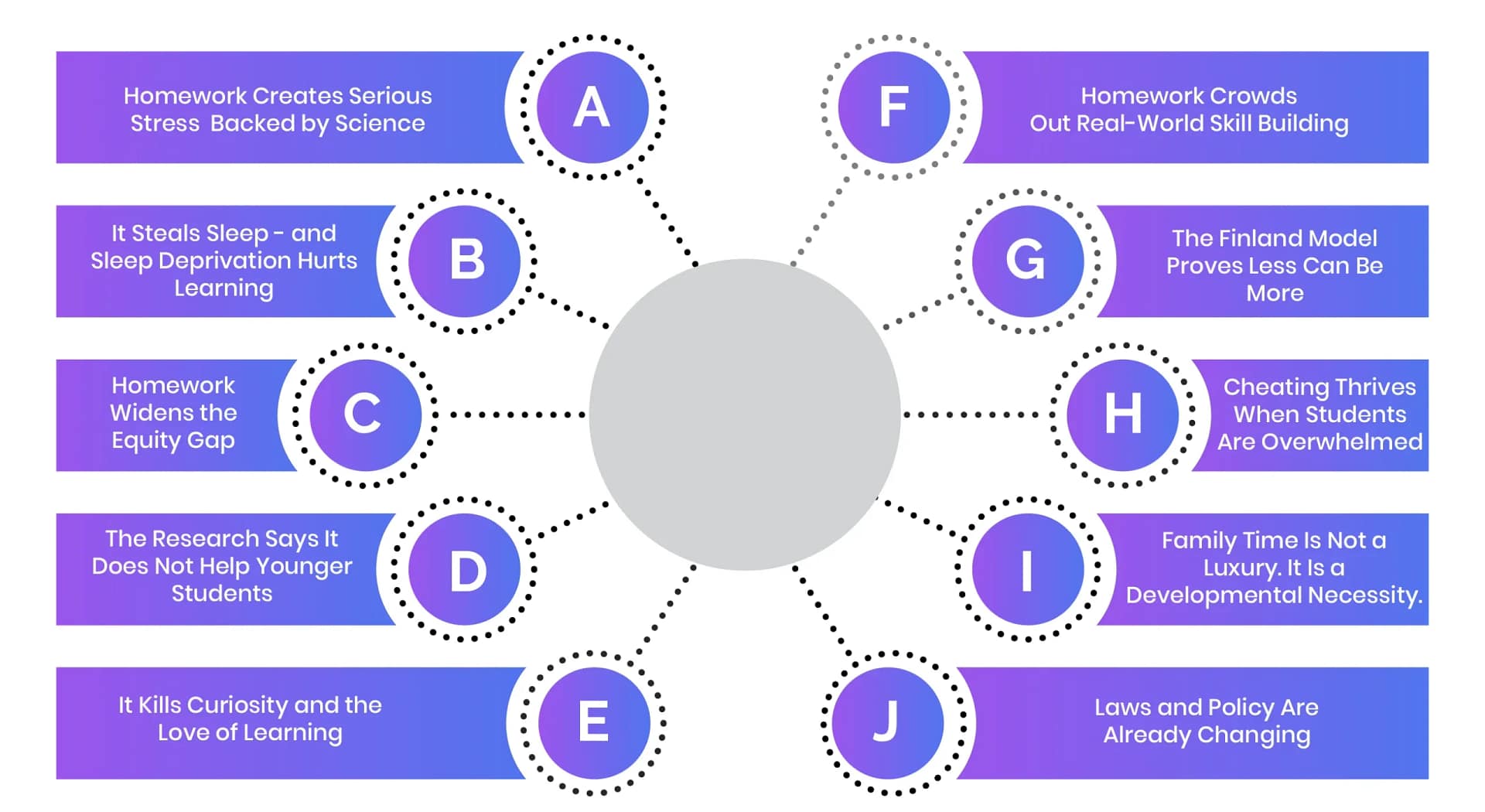
- Homework Creates Serious Stress Backed by Science
- It Steals Sleep - and Sleep Deprivation Hurts Learning
- Homework Widens the Equity Gap
- The Research Says It Does Not Help Younger Students
- Homework Load vs. Academic Performance: A Global Comparison
- It Kills Curiosity and the Love of Learning
- Homework Crowds Out Real-World Skill Building
- The Finland Model Proves Less Can Be More
- Cheating Thrives When Students Are Overwhelmed
- Family Time Is Not a Luxury. It Is a Developmental Necessity
- Laws and Policy Are Already Changing
- What Should Replace Homework?
- How AI Faculty Can Help: Smarter Learning Without the Homework Burden
- What AI Faculty Tool Actually Does
- 5 Ways AI Faculty Tools Replace the Need for Traditional Homework
- AI Faculty in Action: What This Looks Like in Real Schools
- The Bigger Picture: AI + No Homework = A Better System
- Conclusion
- FAQs
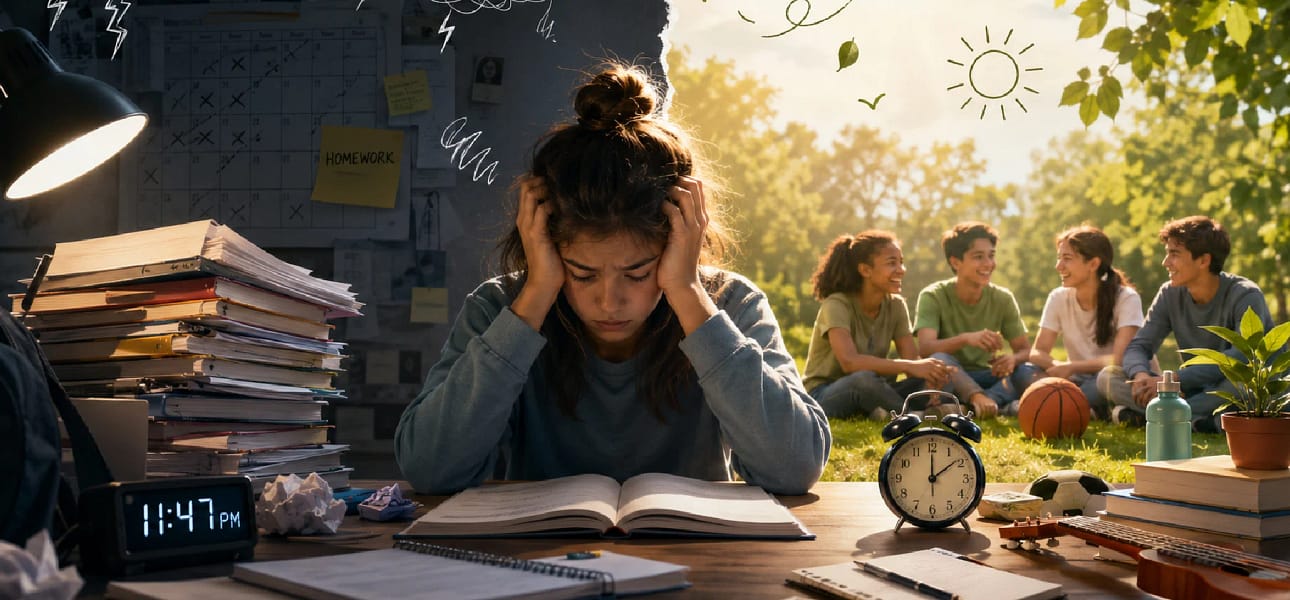
Why should homework be banned? It is one of the most searched questions in education today — and for good reason. Every evening, millions of students across the United States open their backpacks not to explore what excites them, but to grind through assignments they did not choose, do not enjoy, and may not even benefit from. That is not learning. That is compliance dressed up as education.
The homework debate is no longer just a dinner table conversation between frustrated parents and exhausted kids. It has entered legislative chambers, research journals, and school board meetings nationwide. Educators are questioning it. Lawmakers are acting on it. And the data? The data is loud.
In September 2024, California Governor Gavin Newsom signed AB 2999 — the Healthy Homework Act — into law. Effective January 1, 2025, it requires every school district in the state to build evidence-based homework policies that account for student mental and physical health. That is not a minor policy tweak. That is the government formally acknowledging that how we currently assign homework is not working.
And California is not alone. Finland, Estonia, and Denmark have built world-class education systems on the foundation of minimal homework. Countries that assign less after-school work consistently outperform those that assign more — on the very international tests that homework is supposed to help students ace.
This article breaks down exactly why homework should be banned, what the research actually says, and what smarter alternatives — including AI-powered faculty tools — look like in practice. If you are a parent, educator, student, or policy thinker, this one is for you.
Key Statistics at a Glance
|
Homework Creates Serious Stress Backed by Science
Let us start with the most documented reason: homework causes stress. And not just a little.
Stanford University conducted a landmark study surveying over 4,300 students in 10 high-performing California high schools. The findings were striking:
- More than 70% of students said they were “often or always stressed” over schoolwork.
- 56% named homework as the primary driver of that stress.
- Over 80% reported at least one stress-related physical symptom – headaches, exhaustion, or sleep deprivation.
- Less than 1% said homework was not a stressor.
Think about that last number. Less than 1%.
The APA’s 2020 review adds that excessive homework (defined as more than two hours per night for high schoolers) increases anxiety by 25% and raises the risk of depression. We are talking about a measurable mental health impact from an educational practice that is supposed to help students learn.
If a medication produced these side effects, we would pull it from the shelves. Why should an educational policy be held to a lower standard?
It Steals Sleep - and Sleep Deprivation Hurts Learning
Here is a fact that tends to surprise people: sleep is one of the most powerful learning tools we have. The brain consolidates new information during sleep. Cut sleep short, and you cut learning short.
More than 50% of students report that homework causes them to lose sleep. Teenagers are supposed to sleep 8-10 hours a night, according to the American Academy of Pediatrics. But with after-school activities, family jobs, sports, and two to four hours of homework, that goal is more often than not, impossible.
We are essentially asking students to learn better by taking away the biological process that makes learning stick. That is not a strategy. That is a contradiction.
Homework Widens the Equity Gap
Not every student goes home to a quiet desk, a fast Wi-Fi connection, and a parent available to help. Many go home to jobs, childcare responsibilities, shared apartments, or no reliable internet at all.
As per the data of NCES 2022, in the United States, 35% of the low-income students do not have access to home internet. Meaning up to 20% of the digital lessons are left undone- not because of indifference, but due to their unavailability to students.
A study by the RAND Corporation (2021) revealed that compared to urban students, students living in rural areas. do 18% more homework on average and perform 10% worse on standardized tests. More work, worse outcomes – because resources matter.
The Brookings Institution’s 2021 analysis showed that low-socioeconomic-status students complete 28% less homework due to home responsibilities. This widens the academic achievement gap by a measurable margin.
Casey Cuny, the 2024 California Teacher of the Year and a high school English teacher at Valencia High, has already taken action. He told reporters:
“I never want a kid’s grade to be low because they have divorced parents and their book was at their dad’s house when they were spending the weekend at mom’s house.”
Cuny has nearly eliminated homework from his lesson plans entirely. His students’ SAT and AP scores have not dropped. Their engagement has improved. This is not just anecdotal. It is a proof of concept.
The Research Says It Does Not Help Younger Students
Here is what the meta-research actually shows. A 2019 meta-analysis by Harris Cooper – who is arguably the world’s leading expert on homework research – reviewed 198 studies and found:
- Homework shows a positive effect on academic achievement for secondary students with an effect size of just 0.24 – a modest number at best.
- For elementary students, the effect size drops to 0.15, suggesting that homework is nearly ineffective for younger children.
PISA 2015 international data found that students spending zero to two hours per week on homework actually outperform those spending more than five hours – by 17 points in math across 72 countries.
Put simply, beyond a minimal threshold, more homework does not produce better learning. It produces more stress with diminishing academic returns.
Homework Load vs. Academic Performance: A Global Comparison
Country | Avg. Homework/Week | PISA Reading Score | Trend |
Finland | 2.8 hrs | 523 | Less HW, higher scores |
Estonia | 2.1 hrs | 530 (Science) | Minimal HW, top scores |
United States | 6.2 hrs | 505 | More HW, lower scores |
Ireland | 6+ hrs | 504 (Science) | More HW, lower scores |
It Kills Curiosity and the Love of Learning
Ask most students what they think about homework. You will not hear enthusiasm. You will hear about the dread of textbook exercises at 9 PM. And that dread has a long-term consequence: it trains students to view learning as a burden.
Education researchers call this “motivation erosion.” When students associate learning with obligation and punishment, intrinsic motivation – the kind that produces lifelong learners and innovators – gets squeezed out.
The most engaged learners in any field – engineers, entrepreneurs, designers, scientists – did not get there because they ground through worksheets at midnight. They got there because they found something genuinely interesting and pursued it.
Schools that reduce homework often report higher classroom engagement, not lower academic achievement. Students come in more rested, more curious, and more willing to participate. That is the learning environment every teacher wants.
Homework Crowds Out Real-World Skill Building
What do students need most when they leave school? The ability to manage their time, communicate well, think critically, and collaborate effectively. These skills do not develop inside a stack of worksheets.
They develop through activities that homework time directly displaces:
- Team sports and extracurricular clubs build communication and leadership.
- Creative projects and hobbies encourage independent thinking.
- Have a family dinner and create what community you can.
- Rest and play are cognitively crucial for the developing brain.
The Harvard Family Research Project (2018) found that homework overload reduces extracurricular participation by 45%. That is nearly half of all after-school development opportunities being sacrificed for assignments that may not meaningfully improve academic outcomes.
School prepares students for life. Life happens after school, too.
The Finland Model Proves Less Can Be More
Finland is often cited in this debate for good reason. Finnish students do far less homework than American students, averaging just 2.8 hours per week at the primary and lower secondary level. U.S. students average 6.2 hours per week.
And yet, Finland consistently ranks above the OECD average in all PISA subjects. In reading, 79% reached proficiency – well above the global average.
Finland’s philosophy is clear: school should be so effective during the day that students do not need a second shift at home. Teachers in Finland focus on engagement, problem-solving, and collaborative learning inside classroom hours. Students leave energized, not depleted.
This model does not argue that content does not matter. It argues that how and when learning happens is every bit as important as what is being taught.
Cheating Thrives When Students Are Overwhelmed
Proponents of homework argue that it develops integrity and independent learning. The data tells a more complicated story.
A University of Alabama study found that 65 to 75% of students admit to cheating on homework assignments. When students are assigned more than they can reasonably complete with focus and care, they do not rise to the occasion. They look for shortcuts.
The rise of AI tools has made this easier than ever. Students can now submit AI-generated homework answers in minutes. Schools that continue assigning traditional homework in 2025 are not building academic integrity. They are building fluency in avoiding work.
If the goal is genuine learning, overwhelming students with take-home assignments actively undermines it.
Family Time Is Not a Luxury. It Is a Developmental Necessity.
Assemblywoman Pilar Schiavo, who authored California’s Healthy Homework Act, was inspired by a simple conversation with her daughter. Her child asked if she could ban homework. Behind that request was a child who wanted time – time to be a kid, time with her family, time to simply exist outside of academic obligation.
Parents across California and the country echoed that feeling. They expressed frustration at having no quality time with their children because evenings are dominated by homework stress.
Child development research consistently shows that secure family connections and unstructured play time are foundational to healthy cognitive and emotional development. Homework load does not just threaten student well-being. It competes with the conditions that make development possible.
No worksheet teaches empathy, resilience, or a sense of belonging. But dinner with your family might.
Laws and Policy Are Already Changing
This is not just a philosophical argument. Policy is already moving.
- California’s Healthy Homework Act (AB 2999) took effect January 1, 2025, requiring all school districts to develop evidence-based homework policies by the 2027-28 school year.
- Multiple U.S. school districts – including Marion County in Florida and schools in Vermont and Texas – have already eliminated or dramatically reduced homework, particularly at the elementary level.
- Internationally, Finland, Estonia, and Denmark all operate highly effective school systems with minimal homework loads.
- Even historically pro-homework nations are now questioning the practice in light of student mental health data.
The question is no longer whether we should rethink homework. The question is how fast we are willing to do it.
What Should Replace Homework?
Banning homework does not mean abandoning learning after the school bell rings. It means redesigning what intentional learning looks like. Here are evidence-backed alternatives that schools and educators are already putting into practice:
Alternative | Why It Works |
Independent reading (student-chosen) | Develops literacy, vocabulary, and inner drive in a nonintrusive way. |
Project-based learning in class | Real-life problem-solving is applied during school hours. |
Reflection journals | Makes easier personalisation and role models, fully metacognitated and free of any graded tension. |
Family conversation prompts | Bridges helps bring the school-home experience together in a low-demand way. |
Optional enrichment activities | Brings a challenge for students who want to accomplish something without penalizing those who do not. |
How AI Faculty Can Help: Smarter Learning Without the Homework Burden
Here is the elephant in the room: if we ban or reduce homework, how do we make sure students still get enough practice, feedback, and reinforcement?
The answer, increasingly, is AI-powered faculty tools. And the data behind them is compelling.
It reflects a real shift in what educators, administrators, and parents believe is possible – and necessary – in modern learning.
AI faculty tools are not a replacement for great teachers. They are the infrastructure that frees great teachers to do what only humans can do: connect, inspire, and guide.
What AI Faculty Tool Actually Does
AI grading systems can reduce teacher administrative workload by up to 70%. That is 70% of the time teachers currently spend on repetitive assessment tasks-the time which can be effectively utilized in meaningful interaction with students, mentoring, and differentiated instruction! AI tutoring systems are 91% accurate when providing personalized instruction aligned to the learners’ needs.
They’re not gray-box answer engines–they’re systems that know precisely where the student is stuck and meet that need before the student is even aware of it.
As 59% of teachers, AI has already made for more personalized teaching in the classroom. Teachers at the high school level seem to be the most eager – 69% claim they currently use generative AI to supplement their lesson planning.
5 Ways AI Faculty Tools Replace the Need for Traditional Homework
S.No. | AI Capability | What It Replaces & Why It Works Better |
1 | Real-Time Personalized Tutoring | A student struggling with fractions gets a different explanation than one who breezes through them. Traditional homework assigns the same worksheet to both. AI does not. |
2 | Automated, Formative Feedback | Class Companion and other platforms like it respond within seconds with rubric- aligned feedback on students’ writing. Students no longer have to wait for their paper to be marked; they can receive immediate, developmental comments in real time during the day,y not at 11 P.M. |
3 | Adaptive Curriculum Delivery | Learning systems that are AI-driven alter the flow of content delivery based on data captured about how students are performing in real-time (sharp.ai.edu, 2023). Faster if a student progresses quickly, slower if they are unable to grasp the material, aka repetition, is replaced by filler tasks in the form of a ‘learning loop.’ |
4 | Administrative Load Reduction for Teachers | Tools like MagicSchool.ai that manage lesson planning, IEP documentation, parent communication, and scaffolding generation allow more time for teachers to spend on those face-to-face moments that can never be provided through homework. |
5 | Data-Driven Early Intervention | AI tools analyze student performance patterns and alert teachers to emerging gaps before they become serious. A teacher using AI insights can intervene in week two rather than discovering the issue at semester’s end. This makes in-school time far more impactful than any take-home assignment. |
AI Faculty in Action: What This Looks Like in Real Schools
A 2025 survey of more than 800 higher education institutions found that 57% are now prioritizing AI integration, up from 49% in 2024. The shift is not just happening in universities.
At the K-12 level, schools that have deployed AI tutoring and feedback platforms consistently report three outcomes:
- Students get faster, more personalized feedback than traditional homework grading ever provides.
- Teachers identify learning gaps earlier and spend more time on high-value instruction.
- Students report higher engagement because the learning feels responsive to them, not standardized for them.
The Bigger Picture: AI + No Homework = A Better System
Think of it this way. Traditional homework was a workaround. Teachers could not give every student individual attention in a class of 30, so they sent work home,e hoping the learning would continue. AI removes the need for that workaround.
With AI faculty tools embedded in school hours:
- Every student gets a personalized learning path – not a one-size-fits-all worksheet.
- Gaps get identified and addressed in real time, not at report card time.
- Teachers function as mentors and facilitators, not assignment distributors.
- Students go home to rest, explore, and connect – which is exactly what developing brains need.
- Equity gaps narrow, because AI support is available to every student in the school building – not just those with resources at home.
AI does not replace the teacher. It replaces the inefficiency. And that changes everything.
Conclusion
The case for banning homework – or at least fundamentally reforming it – is not built on laziness. It is built on evidence.
Homework as it currently exists in most U.S. schools is a system that creates measurable stress, disrupts sleep, widens equity gaps, breeds academic dishonesty, and delivers modest-at-best academic returns. Meanwhile, Finland and other leading education nations demonstrate that high achievement and low homework can coexist – and often do so by design.
California’s Healthy Homework Act is a meaningful step forward. So are the teachers, like Casey Cuny, who are already doing the work of reimagining what learning looks like after 3 PM.
The goal of education is to produce capable, curious, resilient human beings. That goal is not advanced by a system that leaves students exhausted, anxious, and sleep-deprived every night.
Students deserve evenings. They deserve rest. They deserve to be kids. And the evidence strongly suggests that giving them that back will make them better learners, not worse ones.
FAQs
1. Why should homework be banned for elementary school students?
Research shows that homework has almost no measurable benefit for young learners. At the elementary level, what children need most is play, rest, family connection, and age-appropriate exploration. Heavy homework loads at young ages are more likely to create a negative association with learning than to improve any academic outcome. Many education experts recommend that elementary school students have little to no assigned homework beyond light reading.
2. Does banning homework hurt academic performance?
Not according to the evidence. Countries with minimal homework – like Finland and Estonia – consistently rank among the world’s top performers in reading, science, and mathematics. In the United States, teachers who have eliminated homework report no drop in standardized test scores and significant improvements in student engagement and classroom participation.
3. Is there a difference between useful homework and harmful homework?
Yes, and this is very important to remember. “Repeating practices, along with tasks like worksheets that are too long or busy work that is not high quality, rarely cause learning, but they often cause stress.” To help reinforce learning, teachers and students might choose to work on shorter, more focused, student-selected activities, like “reading a novel that they are interested in or creating a small work of art. The debate is not really about whether any learning should happen at home. It is about whether mandatory, graded, quantity-driven homework serves students well.
4. How does homework affect students with learning differences or disabilities?
Children with ADHD, dyslexia, or other processing disorders or learning differences will find certain tasks much more difficult than a ‘neurotypical’ child. For example, what takes a ‘typical’ student 20 minutes to do for the same result may take a student with a learning disability two hours. Homework policies that do not account for these differences effectively penalize students for disabilities, not lack of effort or knowledge.
5. What is the ‘ten-minute rule’ and does it actually work?
The ten-minute rule is a guideline endorsed by the National PTA and the National Education Association. It recommends that homework should not exceed ten minutes per grade level per night – so first graders get ten minutes, fifth graders get fifty minutes, and tenth graders get one hundred minutes. In practice, many U.S. schools far exceed this guideline, particularly at the high school level. When schools apply this rule consistently, students and parents report significantly reduced stress without any corresponding decline in achievement.
6. What are the alternatives to traditional homework?
Several approaches have shown strong results. Independent reading of student-chosen books is one of the most consistently supported alternatives. Project-based learning that takes place during school hours is another. Some schools use family conversation prompts or optional enrichment activities to connect home and school without creating obligation or stress. The key principle is that any after-school learning should be purposeful, low-pressure, and sensitive to the realities of students’ home environments.


Get Started with AIFaculty Today.
Pick the tools that best suits your business requirement. Level up your marketing and drive desired outcomes.