

- Introduction
- What Is AI in Education?
- Why AI in Education Is No Longer Optional
- Key AI Technologies in Education
- Benefits of AI in Education
- Real-World Examples of AI in Education
- AI in Higher Education: A Closer Look
- AI in K-12 Classrooms
- Why AI Should Not Be Used in Education - The Honest Conversation
- How Institutions Can Use AI Responsibly
- The Future of AI in Education
- Conclusion
- FAQs
Think back to the last time you sat in a lecture hall where one professor addressed 300 students, delivered the same content at the same pace, and gave everyone the same exam. How many of those 300 students actually learned what they needed, in the way that worked best for them? The answer, if we are being direct, is – not enough.
Education has long operated on a one-size-fits-all model that serves some students beautifully and leaves others behind. Artificial intelligence is changing that equation. It is bringing personalization, efficiency, and accessibility to learning at a scale no human teacher – however gifted – could achieve alone.
But AI in education is not without its complications. The technology is powerful. The adoption is accelerating. And the conversation about where it helps and where it creates new concerns is one every institution needs to have right now.
This article covers all of it – what AI in education means, how it works, real-world use cases, the genuine benefits, the legitimate concerns, and what responsible adoption actually looks like.
What Is AI in Education?
AI in education refers to the application of artificial intelligence technologies – including machine learning, natural language processing, computer vision, and generative AI – to improve, personalize, and streamline teaching, learning, and institutional administration.
At its simplest, AI in education means using intelligent software to do things that previously required human effort: grading assignments, answering student questions, identifying learning gaps, generating lesson plans, and adapting content in real time based on how a student is performing.
At its most sophisticated, it means building learning environments that respond to each student as an individual – adjusting the pace, format, depth, and style of content delivery based on data that reflects how that specific student learns best.
AI in education spans every level of the system. It operates in K-12 classrooms, undergraduate lecture halls, postgraduate research programs, corporate training environments, and the administrative back offices that keep institutions running. It touches students, faculty, administrators, and parents – often simultaneously.
What AI in education is not is a replacement for teachers, faculty, or human judgment. It is a tool – a powerful one – that amplifies what good educators do and gives students access to support that would otherwise be unavailable to them.
Why AI in Education Is No Longer Optional
The numbers behind AI adoption in education are striking – and they are moving fast.
- The global AI in education market is expected to reach USD 73.7 billion by 2033, growing from USD 3.6 billion in 2023 at a CAGR of 35.10%.
- Student use of AI surged from 66% in 2024 to 92% in 2025, with generative AI use for assessments rising from 53% to 88% in the same period.
- 62% of academic institutions are preparing to integrate AI into their operations within the next two years.
- 75% of higher education leaders believe AI will play a critical role in shaping the future of their institutions.
- A survey found that 55% of respondents believe AI has already improved educational outcomes.
- AI tools can reduce the cost of education administration by 20–30%, making institutions leaner and more resource-efficient.
These figures tell a clear story. AI in education is not a pilot program or a fringe experiment. It is a mainstream shift that is already underway – in classrooms, in research offices, in student support centers, and in administrative departments across every region of the world.
Institutions that move thoughtfully and decisively will define what modern education looks like.
Key AI Technologies in Education
Understanding AI technologies in education requires looking at the specific tools and capabilities that drive the most meaningful outcomes. Here are the core technologies at work:
1. Machine Learning (ML)
Machine learning algorithms analyze patterns in student data – performance trends, engagement levels, time spent on tasks, common errors – and use those patterns to predict future outcomes and personalize learning experiences. ML powers adaptive learning platforms that adjust content difficulty in real time based on how a student is performing.
2. Natural Language Processing (NLP)
NLP enables AI systems to understand, interpret, and generate human language. In education, NLP powers AI tutors that answer student questions in plain language, automated essay grading tools that assess writing quality, and chatbots that handle student inquiries around the clock.
3. Generative AI
Generative AI – including tools like large language models – creates original content on demand. In education, this means generating customized quiz questions, drafting lesson plan outlines, producing differentiated reading materials at multiple complexity levels, and providing detailed written feedback on student work.
4. Computer Vision
Computer vision allows AI to interpret and analyze visual information. In educational contexts, it powers tools that assess student engagement in online learning environments, read handwritten student work, and support accessibility features for students with visual impairments.
5. Intelligent Tutoring Systems (ITS)
ITS platforms combine multiple AI technologies to simulate one-on-one tutoring. They assess a student’s current knowledge, identify gaps, deliver targeted instruction, and adjust their approach based on the student’s responses – all without requiring a human tutor to be present.
6. Predictive Analytics
Predictive analytics tools analyze historical student data to identify students at risk of disengagement, poor performance, or dropout – early enough for intervention to make a real difference. For institutions focused on retention, this is among the most impactful AI applications available.
Benefits of AI in Education
The benefits of AI in education are broad, well-documented, and increasingly measurable. Here are the most significant:
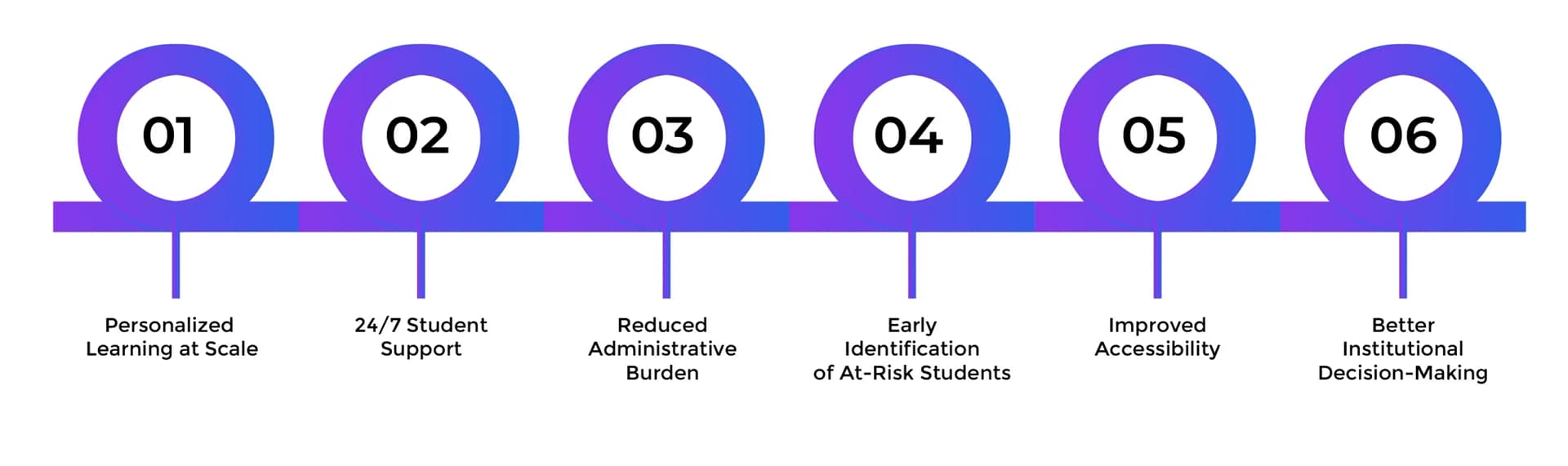
1. Personalized Learning at Scale
Every student learns differently. AI makes it possible to deliver a genuinely personalized learning experience to every student – not just those lucky enough to afford private tutoring. Adaptive platforms adjust the pace, format, and depth of content based on individual performance data, ensuring each student moves forward at the right speed with the right level of support.
2. 24/7 Student Support
AI-powered chatbots and virtual assistants give students access to help whenever they need it – not just during office hours. Whether a student is working through a problem at midnight before an exam or navigating financial aid options on a Sunday afternoon, AI ensures support is always available.
3. Reduced Administrative Burden
Faculty and staff spend enormous amounts of time on tasks that AI can handle more efficiently – grading routine assignments, answering frequently asked questions, scheduling, generating reports, and processing paperwork. When AI absorbs these tasks, educators reclaim time for the work only humans can do: mentoring, inspiring, and building relationships.
4. Early Identification of At-Risk Students
Predictive analytics tools allow institutions to identify students who may be struggling before their performance deteriorates significantly. Early intervention – a conversation with an advisor, a targeted resource recommendation, a check-in from a counselor – can change the trajectory of a student’s academic journey entirely.
5. Improved Accessibility
AI is making education more accessible for students with disabilities. Real-time captioning, text-to-speech, speech-to-text, and AI-powered reading support tools remove barriers that have historically prevented students from participating fully in educational environments.
6. Better Institutional Decision-Making
When administrators have access to AI-driven insights – about enrollment trends, resource allocation, curriculum effectiveness, and student outcomes – they make better decisions. Data replaces intuition, and patterns become visible that would otherwise take years to recognize.
Real-World Examples of AI in Education
The most compelling case for AI in education is not theoretical – it is the institutions already using it to deliver real results.
1. AI Faculty – Personalized AI Teaching Support, Anytime and Anywhere
AI Faculty is an AI-powered teaching assistant platform built for schools, coaching centers, IIT institutes, and universities. It serves teachers and students with equal purpose. For teachers, AI Faculty functions as an intelligent co-instructor – handling doubt resolution, generating concept explanations, and supporting lesson delivery so that educators can direct their energy toward deeper, higher-order teaching. For students, it is a personalized learning platform accessible at any time, from any location. It breaks down complex topics into the clearest possible explanations, responds to doubts instantly, and adapts to each learner’s individual pace and level of understanding. Whether a student is preparing for IIT-JEE at a coaching center, studying at a K-12 school, or revising for university examinations, AI Faculty delivers consistent, curriculum-aligned support – making quality learning available to every student, not just those with access to premium resources.
2. Georgia State University – AI Chatbot for Student Retention
Georgia State University deployed an AI chatbot called Pounce to communicate with incoming students over the summer before their first semester. The chatbot answered questions, addressed concerns, and provided personalized reminders about enrollment steps. The result was a measurable reduction in summer melt – the phenomenon where admitted students fail to enroll – particularly among low-income and first-generation students.
3. Macquarie University – AI-Assisted Learning Outcomes
At Macquarie University, AI utilization resulted in an increase of up to 10% in student exam results, demonstrating clear, quantifiable academic benefits from thoughtful AI integration into the learning environment.
4. Carnegie Learning – Intelligent Math Tutoring
Carnegie Learning’s MATHia platform is one of the most studied intelligent tutoring systems in education. It uses AI to deliver personalized math instruction that adapts to each student’s pace and learning patterns. Research has consistently shown that students using MATHia outperform peers receiving traditional instruction, particularly in algebra.
5. Duolingo – AI-Powered Language Learning
Duolingo uses machine learning to personalize language learning paths for over 500 million users globally. Its AI tracks individual error patterns, adjusts lesson difficulty, and times review sessions using spaced repetition algorithms – producing learning outcomes that rival traditional classroom instruction for many learners.
6. Arizona State University – AI for Academic Advising
Arizona State University uses AI-powered advising tools to help students navigate degree requirements, identify courses that align with their goals, and stay on track for graduation. The system processes thousands of data points per student to surface relevant recommendations – the kind of individualized attention that human advisors alone could never deliver at scale.
AI in Higher Education: A Closer Look
Higher education institutions face a unique set of operational realities – decentralized governance, research complexity, diverse student populations, and rising expectations from accreditors and employers. AI addresses each of these directly.
In teaching and learning, AI powers adaptive course design, automated feedback on assignments, and AI tutoring tools that give students access to support beyond what faculty office hours can provide.
In research, AI accelerates literature review, identifies patterns in large datasets, and surfaces collaboration opportunities between faculty members whose work intersects in non-obvious ways.
In student services, AI chatbots and virtual assistants handle high volumes of routine inquiries – about financial aid, registration, housing, and campus policies – freeing human advisors to focus on complex, high-stakes student situations.
In administration, AI automates reporting, supports budget forecasting, and helps institutions prepare for accreditation reviews by maintaining organized, current documentation of processes and outcomes.
The most common AI applications among educators include research and content gathering at 44%, creating lesson plans at 38%, summarizing information at 38%, and generating classroom materials at 37% – representing a significant reclaiming of educator time and energy.
AI in K-12 Classrooms
In K-12 education, AI is making its most direct impact on personalized learning, teacher support, and student engagement.
59% of teachers reported that AI enabled more personalized instruction, with high school teachers being the most active adopters at 69%, compared with 42% of elementary teachers.
AI tools in K-12 classrooms are being used to:
- Generate differentiated reading materials at multiple Lexile levels for diverse classrooms
- Provide real-time feedback on student writing, identifying structural and grammatical patterns
- Power adaptive math and reading programs that adjust difficulty based on student performance
- Support English language learners with AI-assisted translation and language support tools
- Give teachers dashboards that show class-wide performance patterns at a glance
Over 51% of educators have incorporated AI-powered games to make learning more interactive and engaging – reflecting a growing recognition that student engagement and learning outcomes are closely linked, and that AI can meaningfully support both.
AI is not a distant future for K-12 education. It is the present – and its role will only deepen.
Why AI Should Not Be Used in Education - The Honest Conversation
A credible article on AI in education must address the concerns directly. There are legitimate reasons why thoughtful educators, researchers, and policymakers are urging caution alongside adoption.
1. Academic Integrity
Plagiarism and cheating are reported by 72% of educators as the primary concern regarding AI, and the concern is well-founded. When a student submits an AI-generated essay as their own work, they are not learning – they are performing the appearance of learning. The long-term consequence is a graduate who cannot think independently in the situations their qualification promises they can handle.
2. Reduced Critical Thinking
Over-reliance on AI may lead to reduced critical thinking, as students increasingly offload cognitive effort, and a loss of agency, where learners feel less in control of their own learning processes. Education is not just about acquiring information – it is about developing the capacity to analyze, evaluate, and create. AI that does the thinking for students undermines this development.
3. Student Emotional Well-Being
Survey responses revealed deep concern that AI use, particularly chatbots, is undermining students’ emotional well-being, including their ability to form relationships, recover from setbacks, and maintain mental health. Human connection is not a soft benefit of education – it is foundational to healthy development, particularly for younger students.
4. Data Privacy
AI systems require data to function – often large amounts of sensitive student data. The use of AI often involves collecting and analyzing large amounts of student data, raising concerns about data privacy, security breaches, and the potential misuse of sensitive information. Institutions must be rigorous about what data they collect, how it is stored, and who has access to it.
5. Equity and Access
Fewer than 10% of schools and universities have developed institutional policies or formal guidance on the use of generative AI. Without governance frameworks, AI risks becoming a tool that benefits well-resourced institutions and students while leaving underfunded schools and marginalized communities further behind.
These are not arguments against AI in education. They are arguments for thoughtful, governed, human-centered AI adoption – the kind that amplifies learning without replacing the irreplaceable human elements of education.
How Institutions Can Use AI Responsibly
The institutions getting AI right are not those adopting every tool available. They are the ones adopting the right tools, with the right governance, for the right purposes.
Here is what responsible AI adoption in education looks like in practice:
Develop clear institutional AI policies. Every institution needs documented guidance on how AI can and cannot be used – by students, by faculty, and by administrators. These policies should be specific, regularly reviewed, openly communicated, and enforced consistently across departments.
Invest in faculty and staff training. By Fall 2025, 74% of school districts are expected to start offering AI training sessions for teachers, yet currently 71% of U.S. K-12 teachers lack formal training on AI. Training is not optional – it is the single most important factor that determines whether AI is used effectively or used poorly.
Prioritize student data protection. Any AI tool handling student data must meet institutional privacy standards and applicable regulations, including FERPA in the United States. Data governance must precede deployment, not follow it.
Keep humans in the loop. AI should support human decision-making, not replace it. Grading, advising, counseling, and teaching all benefit from AI assistance – but the final judgment must remain with qualified humans who understand context and nuance.
Measure outcomes. Deploy AI tools with clear success metrics and review them regularly. If a tool is not improving learning outcomes or serving students better – it is not earning its place.
The Future of AI in Education
The trajectory of AI in education points clearly toward more personalized, more immersive, and more proactive learning environments – systems that surface insights before a problem becomes a crisis rather than waiting to be asked.
Longer term, AI will increasingly support the kinds of learning experiences that have historically been available only to the privileged few – genuine one-on-one tutoring, personalized feedback on every assignment, and adaptive learning paths that respond to each individual student in real time. At institutional scale, this is a genuine democratization of educational quality.
The institutions best positioned for this future are those building the knowledge infrastructure today – the organized, intelligently managed systems that AI can draw from and contribute to effectively.
This is where platforms like AI Faculty become strategically important. Purpose-built for higher education, AI Faculty integrates knowledge mapping, AI-powered student support, and institutional intelligence into a single platform – giving universities the organized foundation that makes every other AI initiative more effective. For institutions serious about responsible, high-impact AI adoption, it is worth exploring what AI Faculty makes possible.
Conclusion
AI in education is not coming. It is here – in classrooms, research offices, student support centers, and the administrative systems that keep institutions running. It is improving learning outcomes, reducing administrative burden, increasing accessibility, and giving students access to personalized support that previous generations could only have dreamed of.
It also comes with real responsibilities. Academic integrity, student well-being, data privacy, and equitable access are the conditions under which AI delivers genuine value – not secondary considerations to address later.
The institutions that will lead are not those that adopted AI fastest. They are those that adopted it most thoughtfully – with clear policies, trained faculty, protected student data, and a genuine commitment to using technology in service of human development. The time to make that choice deliberately is right now.
FAQs
1. What is AI in education in simple terms?
AI in education means using artificial intelligence technologies to improve how students learn, how teachers teach, and how institutions operate. This includes tools that personalize learning for individual students, automate routine administrative tasks, answer student questions at any hour, identify students who need support, and help educators design more effective lessons. It covers everything from AI tutors and chatbots to predictive analytics and intelligent grading systems.
2. What are the main benefits of AI in education?
The most significant benefits of AI in education include personalized learning that adapts to each student’s pace and style, 24/7 student support through AI-powered assistants, reduced administrative workload for faculty and staff, early identification of students at risk of falling behind, improved accessibility for students with disabilities, and better institutional decision-making through data-driven insights. Together, these benefits give institutions the tools to serve more students more effectively than traditional approaches allow.
3. What are the best AI technologies used in education today?
The key AI technologies in education include machine learning for adaptive learning platforms, natural language processing for AI tutors and automated grading, generative AI for content creation and personalized feedback, intelligent tutoring systems for one-on-one learning support, computer vision for engagement analysis and accessibility tools, and predictive analytics for student retention and early intervention. Most modern edtech platforms combine several of these technologies to deliver comprehensive learning experiences.
4. Why should AI not be used in education without proper governance?
Without proper governance, AI in education creates risks that outweigh its benefits. These include academic dishonesty when students use AI to complete work for them, reduced development of critical thinking and independent reasoning, threats to student data privacy, potential erosion of the human connections that are essential to healthy educational development, and the widening of equity gaps if AI tools are accessible only to well-resourced institutions. Responsible AI adoption requires clear institutional policies, faculty training, data protection, and ongoing outcome measurement.
5. How is AI being used in higher education specifically?
In higher education, AI is being used across teaching, research, student services, and administration. Faculty use AI to generate lesson content, provide personalized feedback, and identify student learning gaps. Research offices use AI to accelerate literature review and surface collaboration opportunities. Student services teams use AI chatbots to handle high volumes of routine inquiries. Administrators use AI for reporting, budget forecasting, and accreditation preparation. The most effective institutions are those using AI across all four areas in a coordinated, governed way – not as isolated point solutions.


Get Started with AIFaculty Today.
Pick the tools that best suits your business requirement. Level up your marketing and drive desired outcomes.